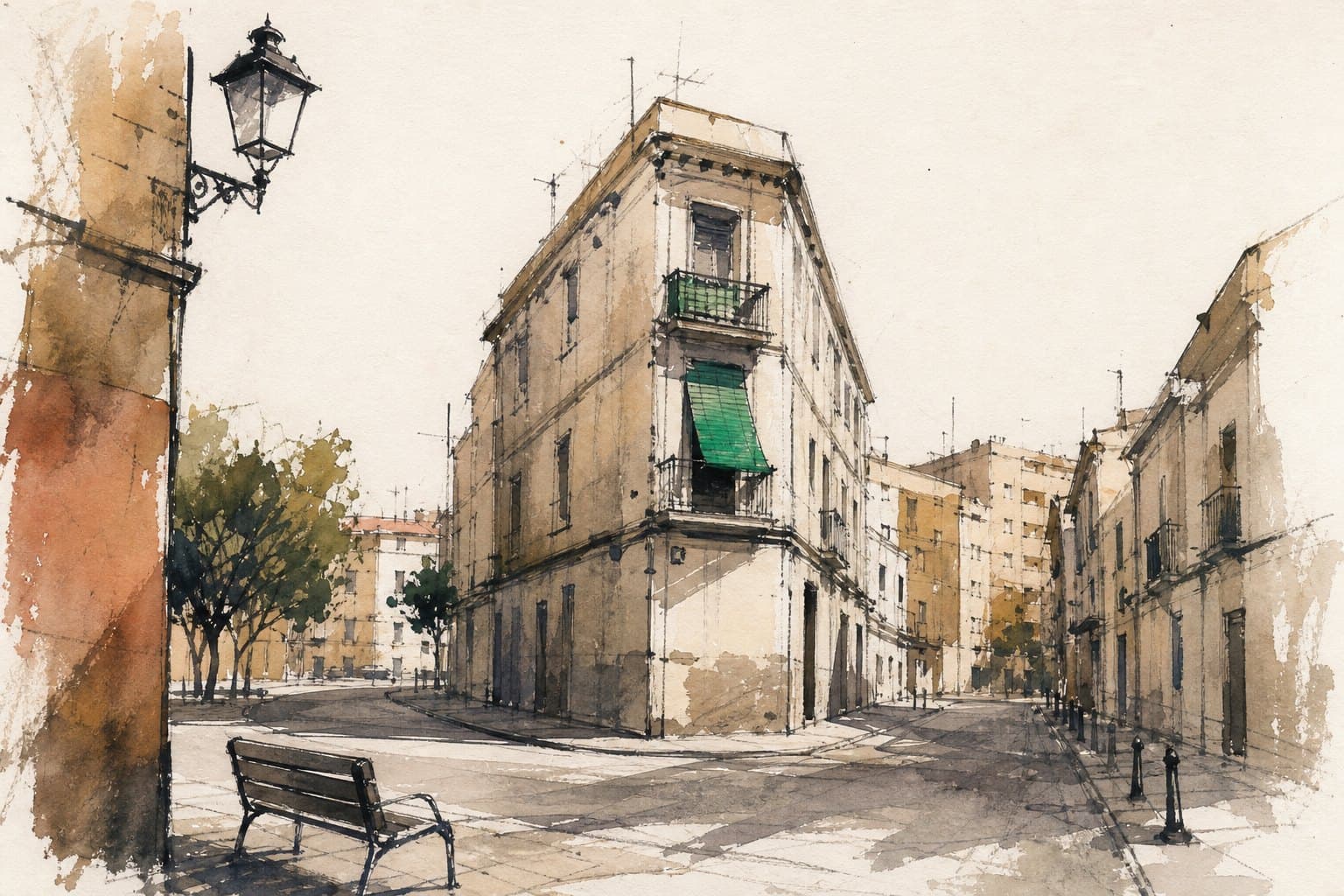
A cluster of tents outside Valencia’s City Hall brought the arithmetic of home into the open: one local report describes Andrea, a 24-year-old social educator, paying €250 plus bills for a room she characterises as barely three square metres. Her line is startling not because it claims to explain every tenancy in the city, but because it makes the unit of the housing conversation painfully small: not a flat, not a mortgage, but a bed-sized piece of private space.
The same report places Andrea and another young participant, Paula, among people protesting the distance between pay, rent and the possibility of living independently. Their accounts should be read as accounts, rather than as a statistical portrait of every young Valencian. Still, they give a name and an address-shaped outline to a calculation many residents will recognise while scrolling listings or adding up monthly transfers.
«Pago 250 euros más gastos por un cuchitril de nada»
That sentence matters because it changes what “affordable” can mean. A price may look manageable when set beside more expensive rooms; it can still buy very little privacy, leave little room for surprises and make the word bargain feel upside down.
When a room becomes the whole plan
According to the local report, Andrea earns a net €1,600 a month and had looked with her partner in Benimaclet, where they found no options below €1,000. The pair reportedly moved instead to a fourth-floor flat without a lift in Marchalenes for €800. After the relationship ended, the report says, she returned to Benimaclet to rent the tiny room.
There is no need to turn that sequence into a slogan. It simply shows how housing decisions can be tied to other decisions that do not arrive on a neat timetable: a relationship ending, a job location, the need for a lift, a car repair, a health expense. A home is often described as a destination. In everyday life, it is also the thing that determines how much disruption a person can absorb.
For anyone searching for a place in Valencia, the most honest budget is therefore not the advertised rent alone. It is the rent, bills, deposit, moving costs and the amount left after them. The useful question is not whether a room can be paid for in an ordinary month, but whether it still works in the month when something ordinary goes wrong.
Benimaclet, Marchalenes and the map of compromise
The route from Benimaclet to Marchalenes in the report is more revealing than a ranking of districts. It suggests that a housing search is rarely just about finding a cheaper pin on a map. It is a negotiation between the neighbourhood one knows, the building one can tolerate and the journey one is willing to make every day.
Benimaclet appears in the account as the place Andrea wanted to remain and later returned to, albeit in a drastically smaller room. Marchalenes appears as the alternative that made an €800 shared home possible for a time, with the reported trade-off of four flights of stairs. Neither detail tells a visitor where they should live; both show why a district’s appeal cannot be separated from the kind of home available inside it.
For newcomers, this is a good reason to visit a prospective street at the hour they would actually use it. Walk the route to work, the supermarket and the nearest transport stop. Look at the entrance, the stairs and the windows, not only the photos. The report’s figures are particular to two people, but the habit of checking the whole daily route is useful to anyone weighing a move.
Those beginning that search can use our rental guide as a starting point, then let the practical shape of their own week do the deciding. A cheaper address that adds an exhausting commute or removes a basic convenience may not be cheaper in the way that matters.
The commute as a housing payment
Paula’s story, as reported, puts time alongside euros. The 25-year-old travelled from Cheste to the Blasco Ibáñez university campus, with a train journey of about an hour each way because Valencia rents were beyond reach. For her master’s course, the report says she enrolled in Ontinyent, where shared-room prices were said to range from €160 to €200, and shared a ground-floor home with three others.
The important detail is not that one town is cheaper than another; a single report cannot settle that. It is that housing cost can reappear as travel time, timetable dependence and a narrower choice of where to study. A monthly budget has a second column that is easy to overlook: the hours spent getting to the life the budget is meant to support.
Students and workers weighing an outer address can make that column visible before committing. Put the first departure, last return and the cost of missed flexibility beside the rent. It is a more revealing exercise than comparing two headline prices, and it respects the fact that an inexpensive room may ask for a great deal in return.
- Reported room cost: Andrea’s room was €250 plus bills.
- Reported flat search: Andrea and her partner found no Benimaclet option below €1,000.
- Reported study commute: Paula travelled from Cheste to the Blasco Ibáñez campus in about an hour by train.
What a housing conversation should leave room for
The protest camp may be temporary, but the questions carried into the square are not. The local account records Andrea looking at her parents’ mortgage and concluding that ownership did not feel like a path she wanted or expected to take. Paula, according to the same report, saw individual independence as out of reach despite combining work and study.
Those are not forecasts for Valencia, nor are they instructions for how everyone should arrange their lives. They are reminders that “emancipation” is more than moving out on paper. It includes whether the move leaves space for rest, saving, relationships, study and the occasional unwanted bill without turning every one into a crisis.
Valencia will keep offering different versions of the same choice: central room or longer ride, familiar neighbourhood or lower cost, privacy now or savings later. The more plainly those trade-offs are spoken about, the easier it becomes for residents and visitors alike to see a listing as the beginning of a decision rather than the whole decision.