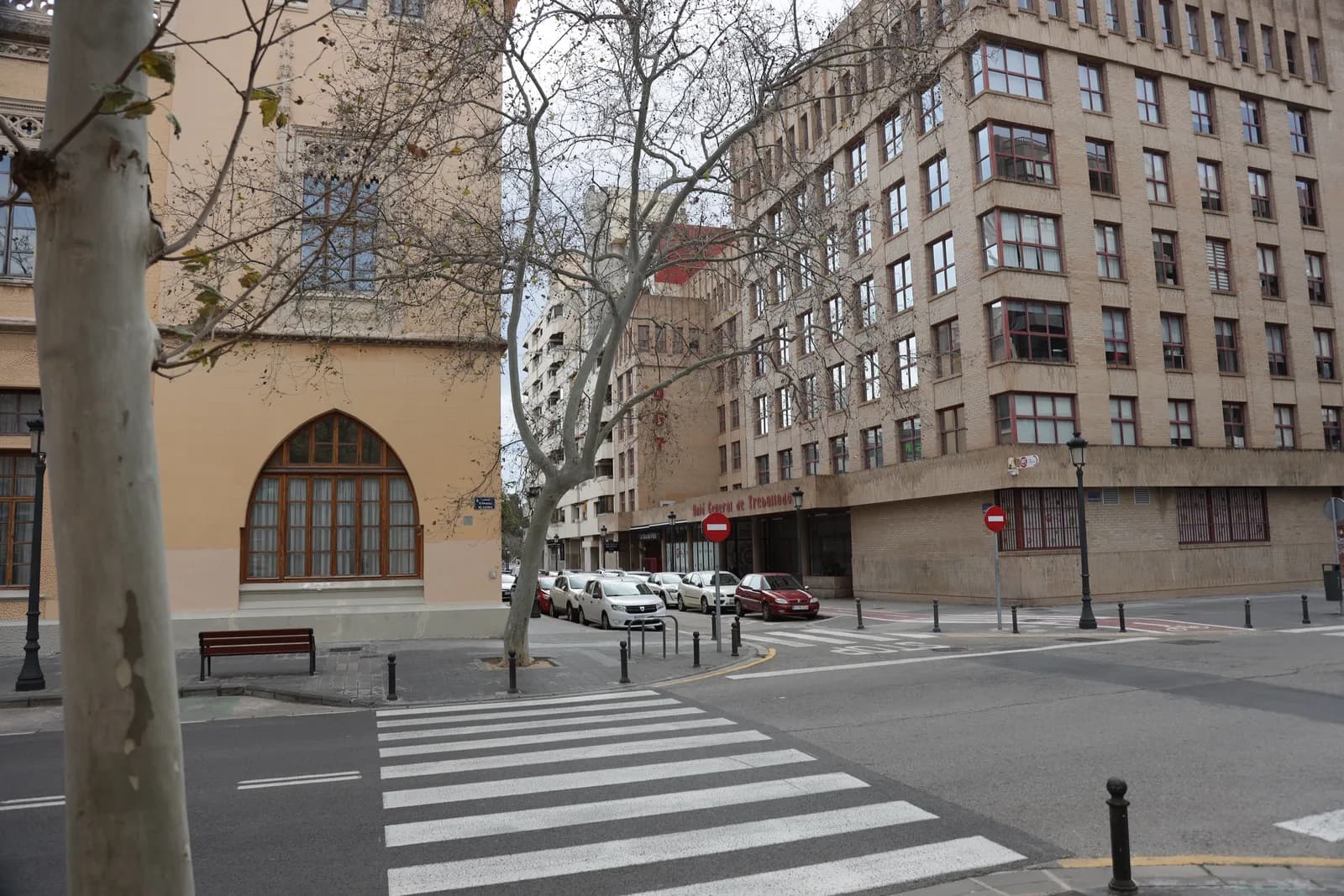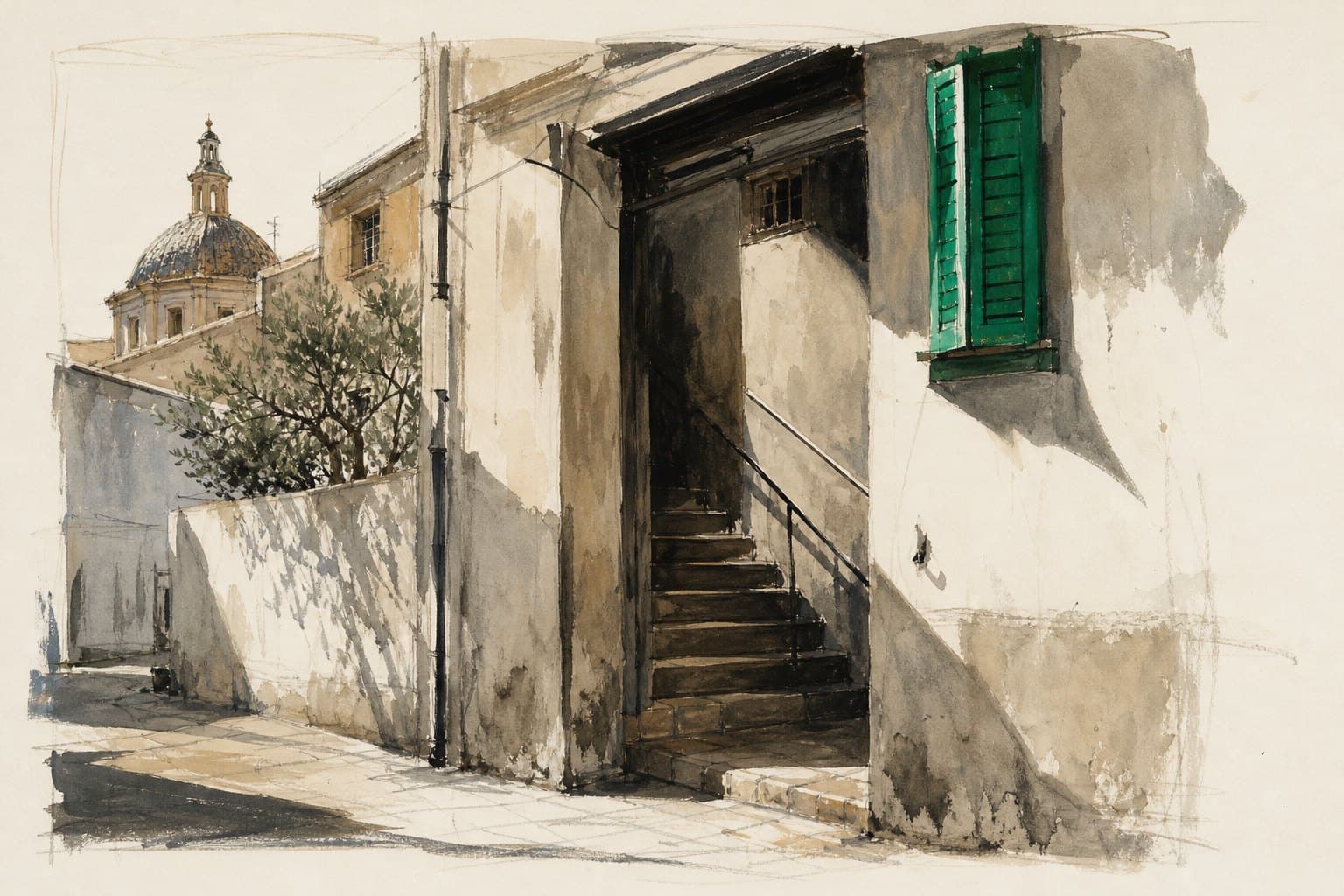
Behind an unassuming door on Calle Aluder, steps from Mercado Central, La Gallera reportedly opens into a room that is far less discreet than its façade. Local reporting describes an irregular, 12-sided interior, with ironwork, a ground floor and two levels reached by a pair of stairs. It is the sort of threshold that changes the scale of a walk: one moment you are in the compact streets near the market; the next, you are looking up.
The building returned to public attention through an Open House visit, but the more lasting story is not the festival. It is the pleasure of discovering that a city can keep an extraordinary interior behind a modest entrance, and that a rehabilitation can make a place usable without sanding away the marks that explain it.
According to local reporting, architect Víctor Condeso, a Lisbon-born Valencia resident, led the restoration after a difficult process involving acquisition and administration. His guiding instinct was reportedly restraint: let the building do the talking. That is a useful phrase for anyone who has watched old spaces become so polished that they no longer have anything left to say.
A theatre built around a vanished spectacle
La Gallera was reportedly built for cockfights, an activity that has long ceased to be a legal public spectacle in Valencia. The central area was the arena, while spectators watched from the levels around it. Whatever discomfort that original purpose prompts now, it helps explain the building’s unusual geometry: this was a machine for seeing, hearing and being seen.
Local reporting suggests that social rank may once have been written into the climb. The first level was thought to have held people with less money, and the uppermost tier those with less still. It is an interpretation rather than a fully documented seating chart, but it gives the familiar word gallinero—the distant, high-up seats in a theatre—an unusually literal echo.
For present-day visitors, the point is not to romanticise the former entertainment. It is to notice what survives when a building outlives the habit that created it. The railings, sightlines and stacked galleries do not need a display panel to announce that they were designed for a crowd gathered around one charged point below.
Look up before looking for an exhibition label. In La Gallera, the stairs and balconies are part of the story, not merely the route through it.
The sound is part of the architecture
Some rooms make people lower their voice without being asked. La Gallera appears to do the reverse: local reporting praises its acoustics, and says its present operators have used the space for concerts. This is not an ornamental bonus. In buildings made for audiences, sound is often the clue that the room’s original logic is still working.
Condeso recalled an opera recital there in which, according to the report, the singer sounded so distinctive that some audience members cried. “Siempre que vengo me emociono,” he said: “Every time I come, I am moved.” The quote is personal, but it captures why preservation can be more persuasive than a before-and-after photograph.
“Siempre que vengo me emociono.”
A cultural programme can give an old building a new reason to open its doors, but it cannot manufacture resonance from nothing. The reported appeal of La Gallera lies in the fit between room and use: people still gather in a circle of attention, only the performance at the centre has changed.
Why the modest entrance matters
Valencia is full of streets that reward slowing down. Near Mercado Central, the obvious landmarks receive much of the gaze, while smaller doorways ask for a different kind of attention. La Gallera reportedly remains easy to miss because of its tucked-away position, despite being close to one of the city’s busiest daily destinations.
That contrast is valuable for residents as much as visitors. A city does not reveal itself only through grand plazas and buildings that advertise their importance from across the road. Sometimes its character sits behind a plain frontage, waiting for an open day, a concert listing or an invitation to make you cross a threshold you normally pass without a glance.
There is also a practical lesson in how to explore the centre. Pair a planned destination with one unplanned turn: leave the market’s immediate flow, walk a side street, and pay attention to doors, plaques and courtyard entrances. For more neighbourhood ideas beyond the postcard circuit, our Ciutat Vella guide is a useful place to begin.
A second life without a costume change
According to local reporting, La Gallera passed from private hands to the Consorcio de Museos before its cultural reuse, and is now run by entrepreneurs Maite Arce and Norberto Soro. The ownership and management details matter less to a casual visitor than what they enabled: a structure with an obsolete purpose was not flattened into a generic venue.
The strongest adaptive reuse projects do not pretend that every old room was originally meant for contemporary tastes. They work with awkwardness—the strange plan, steep ascent, enclosed centre or stubborn acoustic personality—and turn those limits into the reason to come. La Gallera’s reported restoration seems to have chosen that route, keeping its oddness legible rather than disguising it.
That is an encouraging model for Valencia. As more spaces seek a role beyond their first one, the most interesting future may belong to places that retain a little resistance: rooms that ask visitors to climb, listen, look over a railing and understand where they are. A cultural city needs new venues, certainly, but it also needs old rooms that still know how to surprise us.
The takeaway: La Gallera is worth seeking out not as a curiosity from the past, but as an example of how a distinctive room can gain a new public life without losing its shape.