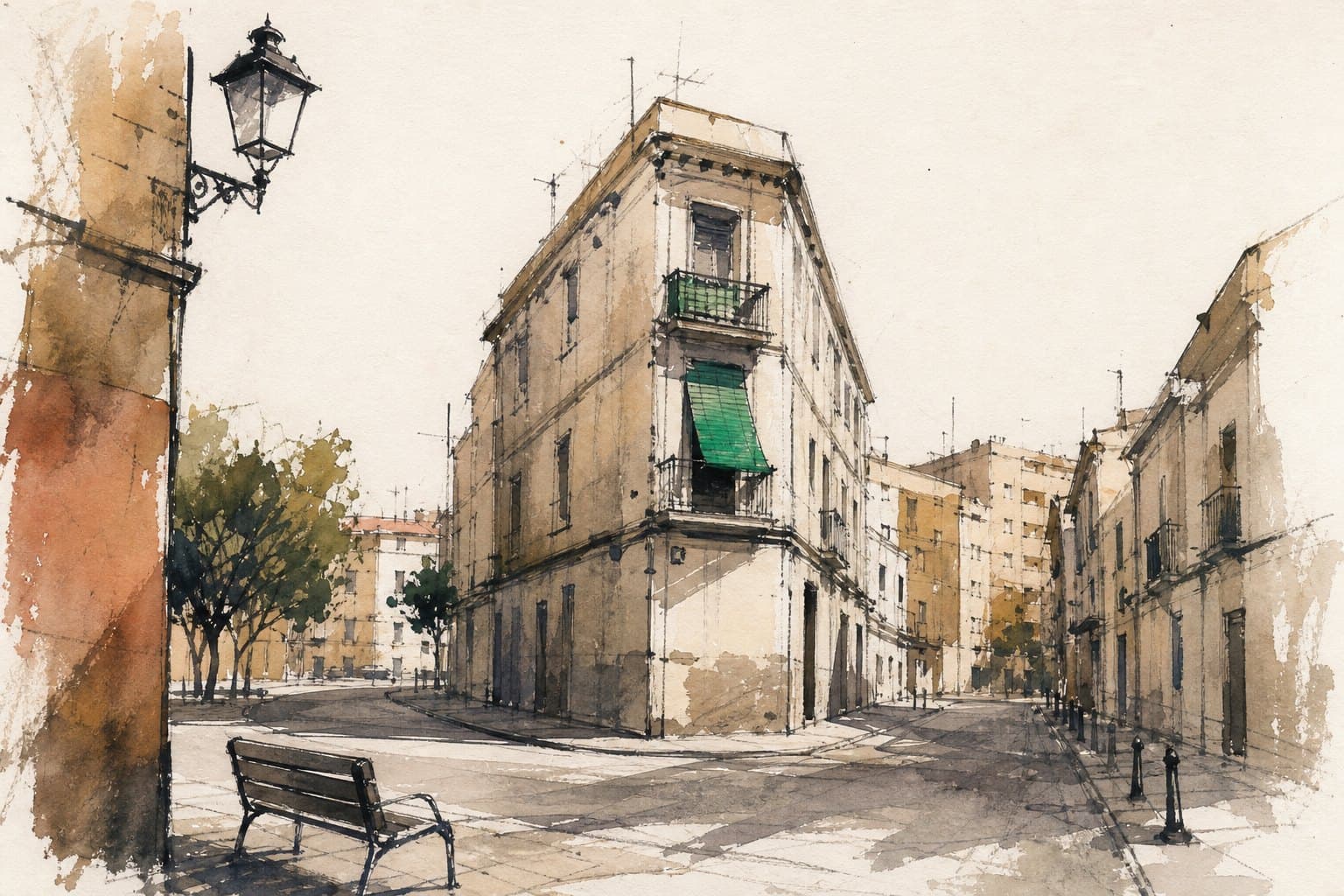
Behind Jubiocio, where Pere Delmonte, Poeta Serrano Clavero and General Llorens meet, a triangular plot is reportedly being imagined as a place for a full symphonic band, 425 listeners and a neighbour with an ordinary reason to come in. Local reporting says 17 companies or consortiums have submitted offers to build the proposed Benicalap auditorium. That crowded tender is the dramatic bit; the more revealing story is the patch of city it points to.
An auditorium is an unusually specific promise. It is not merely a hall with seats: it asks for performers, rehearsal hours, instrument cases, ushers, school groups, late buses and somebody willing to programme a Tuesday evening that is neither a gala nor a municipal ceremony. In return, it gives a neighbourhood something rare in a city built around going elsewhere: a reason to stay out locally.
For international residents, this is one of the useful ways to read Valencia beyond its postcard centre. The city can feel compact when you are crossing it for dinner, yet cultural routines are shaped by where an event finishes, who is going home with children, and whether a concert requires a second journey after work. A hall in Benicalap would make those calculations part of the north rather than an excursion from it.
A cultural map made of journeys
The proposed project is reportedly part of a municipal idea that major performance spaces should not all gather in the centre. Local reporting describes existing reference points in several directions: Teatro El Musical to the east, La Rambleta to the south and the Palacio de Congresos to the west, with Benicalap intended as the northern counterpart. The significance lies in the pattern, not in a checklist of buildings.
Culture is often discussed as though its only currency were ticket price. Time has a price too. A venue close to home changes who can say yes to a weeknight concert, a music lesson or a rehearsal. It can matter to the person who works an early shift, the parent arranging collection, the older neighbour who dislikes a long return journey, and the visitor who would rather understand one district than spend every evening in the same few streets.
That does not mean each area needs to become a miniature city centre. The better version of local culture has its own scale: familiar faces at the entrance, a programme that leaves room for amateur groups as well as touring names, and streets that remain streets rather than a permanent event zone. A 425-seat room, if the reported capacity is realised, suggests intimacy more than spectacle.
What the plans make room for
According to local reporting, the planned building would contain more than an auditorium and stage. The brief includes dressing rooms, an archive, administrative rooms and four teaching rooms, alongside a separate ground-floor area for neighbourhood use. That mix is important because the life of a cultural building is usually decided in the hours when no audience is seated.
The report says the independent local area would have its own entrance, a multipurpose room, an office and services, allowing it to operate without crossing the auditorium’s daily machinery. Such details can sound dry on a plan, but they decide whether a residents’ meeting, workshop or small association has a usable door rather than a polite theoretical invitation.
There is a practical generosity in a room that can be borrowed, booked or inhabited without needing the main hall to be open. Benicalap does not need every gathering to justify a stage crew and a foyer. It needs spaces that can absorb the modest, repeated business of neighbourhood life: a class, a committee, a rehearsal, a conversation that runs longer than expected.
A home for musicians, not only audiences
Local reporting says the building is intended to become the headquarters of Valencia’s Municipal Symphonic Band, with a stage designed to accommodate a complete symphonic ensemble and facilities for large-format rehearsals. The plan reportedly also includes instrument storage, technical areas and direct access between artists’ support spaces and the stage.
Those backstage provisions are easy to overlook from a seat in the stalls. Yet a venue built only for the moment of performance is a decorative shell. Musicians need somewhere to arrive, change, store equipment, practise and wait; staff need loading routes and control rooms; a programme needs a place to be assembled before it is presented. The least glamorous square metres often make the public ones possible.
For a city with a strong musical identity, a purpose-built home can also change the rhythm of an institution. Rehearsals cease to be an invisible problem solved elsewhere and become part of the building’s purpose. If the proposed classrooms are used as described, the distance between learning music and hearing it performed could become pleasingly short: one building, several stages of the same habit.
- Reported budget: €8.52 million.
- Reported capacity: 425 people.
- Reported construction period: 19 months from the start of works.
- Reported site: the plot between Pere Delmonte, Poeta Serrano Clavero and General Llorens.
The difficult part starts after the ribbon
Local reporting says the tender’s next steps include assessment of economic and technical offers before an award is made. It also reports a planned construction period of 19 months once works begin. Those are necessary milestones, but bricks are the straightforward part of the cultural bargain. The harder work is deciding what kind of regular place will emerge when the building is no longer a project.
A neighbourhood venue earns its place through repetition. One memorable opening concert is pleasant; a calendar people can trust is more valuable. That might mean performances with a reasonable local rhythm, teaching that does not vanish after a launch season, and a community room whose independence is real in practice. The best test is unceremonious: can someone in Benicalap name a reason they expect to enter next month?
For visitors, that future could offer a different way to encounter Valencia: not by chasing its most photographed rooms, but by following a programme into a working district. For residents, it may offer something quieter and more durable—a city whose cultural map does not end where the old centre’s streets begin. The triangle behind Jubiocio is only a plot for now; the ambition is to make it part of ordinary life.