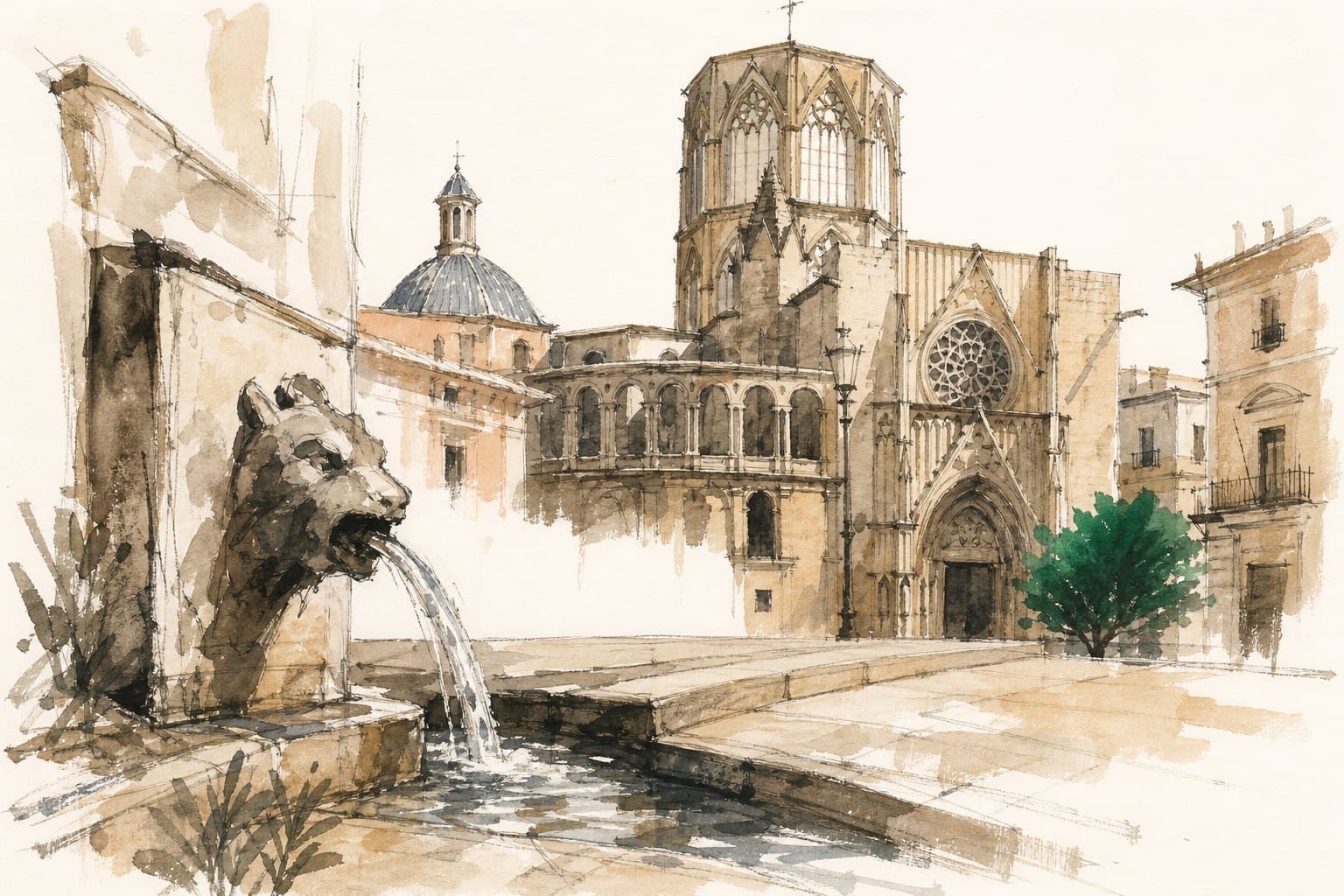
At noon, while the Micalet bells ring, the Tribunal de las Aguas formally convenes at the Apostles’ Door of Valencia Cathedral. It is a working customary court for irrigation-water disputes among farmers in the Vega de València.
- Cases Irrigation-water disputes among farmers in the Vega de València.
- Procedure Public, rapid, oral and entirely in Valencian.
- Decision The síndic of the canal concerned does not decide guilt.
- Origin Unknown; no document explicitly mentions the Tribunal before the 18th century.
- Recognition Intangible Cultural Heritage of Humanity since 30 September 2009.
Why does Valencia’s water court meet at the Cathedral?
The Tribunal meets at the Apostles’ Door because that is where it formally convenes for its public hearing. Its task is specific: it settles conflicts arising from the use of irrigation water among farmers in the Vega de València.
The court’s jurisdiction is tied to the irrigation channels and communities that form the Vega. It is not a general court for every rural disagreement. Its work concerns water used for irrigation, a shared resource governed through those communities’ rules.
The hearing is public, rapid and entirely in Valencian. It is also wholly oral: there is no written procedure and no written record. A complainant presents the case, then the accused responds and answers questions.
For context on the area around the Cathedral, see Ciutat Vella.
How does the Tribunal de las Aguas decide a case?
The members are called síndicos, representatives of the participating irrigation communities. They elect a president from among themselves. The supplied accounts differ over the number of participating communities and over the president’s term, so neither detail can be stated as settled here.
The safeguard in a case is clear. The síndic of the canal involved does not join the decision on whether the accused is guilty. The other members decide that question.
If the defendant is found guilty, the síndic of the relevant canal sets the penalty under that irrigation community’s ordinances. The court therefore separates the decision on guilt from the application of the canal’s own rules.
Before the formal hearing, members meet with advisers at Casa Vestidor in Plaça de la Mare de Déu to discuss matters, mainly water distribution. The public court then convenes at the Cathedral door.
Did Valencia’s water court begin in 960?
Legend: a popular story dates the Tribunal’s foundation to 960. The supplied evidence says that claim has no historical foundation.
The exact origin is unknown. One account says the Tribunal probably evolved from earlier Andalusi traditions; another describes an evolution during the feudal period based on those traditions. The Thursday meeting and the Cathedral-door setting have been cited in support of a Muslim origin, but they are not proof.
Historian Thomas Glick describes the Tribunal as an institution of very long evolution rather than the creation of a king or caliph. That is the more useful way to read its age: there is no confirmed single founding moment.
No document explicitly mentions the Tribunal before the 18th century. That absence does not prove that it did not exist earlier. It does rule out presenting 960 as an established date.
What later evidence exists for the Tribunal?
Spain’s 1879 Water Law confirmed the Tribunal’s existence and privileges. It also used the Tribunal’s organisation as a model for irrigation juries elsewhere in the country.
The Tribunal was designated Intangible Cultural Heritage of Humanity on 30 September 2009. That recognition does not settle its origin, but it identifies the court as a continuing part of Valencia’s irrigation culture.
The Tribunal remains practical rather than decorative: it hears an accusation, allows a response, decides guilt without the relevant canal’s síndic, and applies the canal rules where there is a penalty. Browse places to see in Valencia for other city landmarks, but read this gathering first as a court session.
Why has the Tribunal de las Aguas lasted?
The facts show continuity in a narrow job: resolving disputes over irrigation water. Its procedure is public and oral, and its members come from the irrigation communities involved in managing the canals.
One source presents that continuity and effectiveness as evidence of the Tribunal’s historical importance in managing agricultural water resources. The court’s exact age remains unresolved; its purpose in each case is not.
For more articles about the systems and places that shape the city, visit the ValenciaLink magazine.