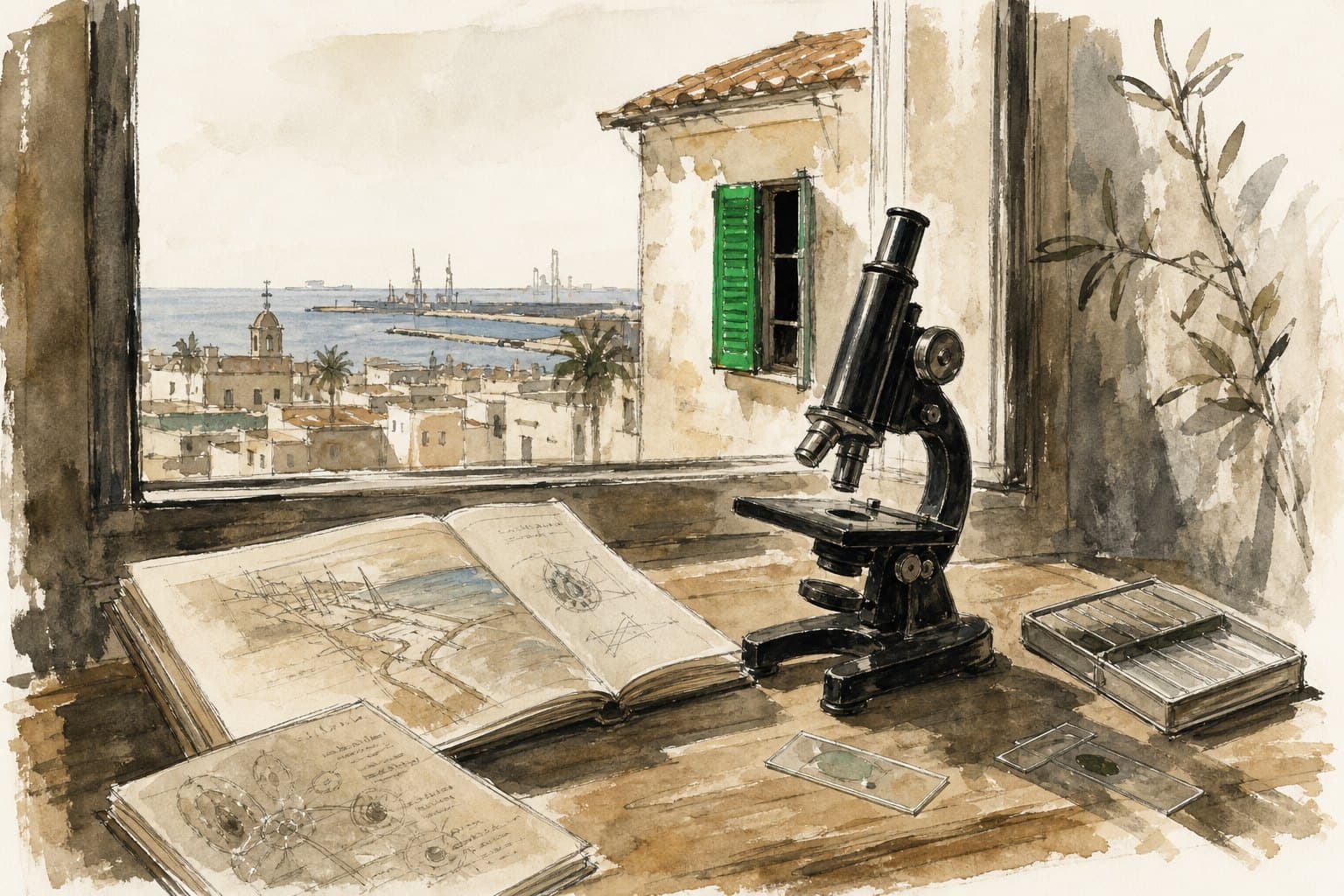
An Ernst Leitz Wetzlar metallographic microscope from 1924 is among the objects reportedly waiting inside Puerto de Sagunto’s new industrial museum. It is a small, precise instrument for a story that can otherwise feel overwhelmingly large: furnaces, shifts, migration, union struggle, a planned company town and the lives built around all of them.
The Museo Industrial y de la Memoria Obrera has reportedly opened in the former Nave Almacén de Efectos y Repuestos, a warehouse once used for moulds and replacement parts. For visitors arriving from Valencia, it offers a useful change of scale. The industrial remains around the port stop being atmospheric backdrops and become clues to how a whole community was organised.
That matters because Puerto de Sagunto is not simply a beachside extension of Sagunto. Its character was reportedly shaped by steelmaking and by the city-factory model that grew around it: work did not sit at the edge of local life; it structured the town’s social fabric.
A building that kept its place
The warehouse itself reportedly dates from 1927, when the Compañía Siderúrgica del Mediterráneo built it to store machinery components. Such a building can look modest beside the grander industrial structures that tend to attract a camera. Yet a store for spares says something unusually human about production: machines broke, workers repaired them, and continuity depended on unglamorous objects being close at hand.
According to a local report, the nave escaped demolition in 1984 and passed to the industrial-heritage foundation in 1994. Its survival is part of the point. Industrial heritage is often discussed as if preservation meant keeping a chimney, a gate or a dramatic frame against the sky. A former warehouse holds a less tidy memory: the systems of maintenance, labour and supply that made the dramatic structures function.
For someone exploring the coast beyond Valencia, that makes the museum a sensible first stop rather than an afterthought. It reportedly spreads its permanent display over three floors, tracing steelmaking, the factory town and workers’ memory. Afterwards, the port’s industrial landscape may look less like a relic and more like a map with its labels restored.
Not only machines, but the people beside them
The museum’s permanent displays reportedly include a 1918 optical level and work clothes from Altos Hornos de Vizcaya, alongside the 1924 microscope. These are not decorative antiques. They point towards different kinds of knowledge: measuring, inspecting, repairing, dressing for a shift. A city’s industrial past is often told through output; these objects bring attention back to the hands and habits behind it.
That focus is explicit in the museum’s reported remit. Its interpretation covers the workers’ movement and struggles for rights, as well as the Civil War, the post-war period and the fight against the closure of Altos Hornos del Mediterráneo. Two temporary exhibitions reportedly concentrate on that latter conflict: La batalla de Sagunt (1983-1984) and Los tiempos del Puerto.
“El patrimonio industrial no son sólo edificios y máquinas, es trabajo, dignidad, esfuerzo colectivo e identidad, y es sobre todo memoria.”
Those words, reportedly spoken at the opening by the councillor for Cultural and Industrial Heritage, describe why this kind of museum is different from a collection of machinery. It asks visitors to see labour as civic history. That can resonate with newcomers, too: understanding why a place protects its factory memory is one way of understanding why certain streets, associations and family stories still carry particular weight.
A visit designed to be shared
According to the local report, the displays use audiovisual material and offer content in Valencian, Spanish and English. Free audio guides and easy-reading resources are reportedly available through QR codes. For international residents and visitors, that practical detail matters: the museum appears to be making an account of local history accessible without requiring prior knowledge of the industry or of Spanish labour history.
The reported visiting hours are Tuesday to Sunday from 10:00 to 14:00, with Friday and Saturday afternoon opening from 16:00 to 19:00. Admission is reportedly free until 31 December. It is worth checking arrangements before setting out, especially if a particular exhibition or guided activity is the reason for the trip.
- Setting Former spare-parts and moulds warehouse, reportedly built in 1927
- Permanent story Steelmaking, the factory town and workers’ memory
- Languages Valencian, Spanish and English, according to the local report
- Access tools QR audio guides and easy-reading resources reportedly free
The reported programme also includes educational workshops, talks and cultural events. That is an encouraging sign for a museum about working life: memory is most alive when it is used by schools, neighbours, former workers and people who have arrived with no inherited connection to the place.
Reading the port beyond the museum door
Valencia has no shortage of polished visitor narratives: silk, ceramics, citrus, modern architecture, the sea. Puerto de Sagunto offers another, more muscular version of the region’s past. It suggests that prosperity and identity are also made in warehouses, on shop floors and in the arguments that follow when work disappears.
That does not require treating the town as an industrial theme park. The useful lesson is quieter. Look at the relationship between a building and the homes, services and social groups around it. Ask what kind of life a workplace made possible, and what happens to that life when the workplace changes. The museum reportedly puts these questions at the centre of its account.
For those getting to know the wider area, places such as Puerto de Sagunto widen the idea of what counts as Valencia’s heritage. The next time an old industrial wall or warehouse appears beyond the usual itinerary, it may be worth seeing not an empty shell but a record of skills, arrivals, demands and futures imagined by the people who worked there.