After 12.30pm, according to local reporting, the Real Senyera moved out from Plaça de l’Ajuntament into a crowd that had spent the morning peering through barriers. People had reportedly called, “¡Queremos ver la Senyera!”, from the parts of the square where the view was blocked; once the procession reached the open streets, the familiar press of heads, raised phones and applause took over.
The 9 d’Octubre civic procession is easy to mistake for a ceremonial appointment on a calendar. From pavement level, it is something more practical: one of the rare occasions when the centre asks residents to decide how closely they want to stand beside strangers, symbols and each other. You do not need to know every office-holder in the procession to understand the essential drama. Will there be room to see? Will the route feel welcoming? Can a ritual that belongs to the whole city remain visible to the whole city?
Local reporting described an unusually tense setting around the square, where a housing-rights encampment was reportedly still in place and a reinforced police presence had narrowed public access. The applause that accompanied the flag along the route mattered not because it settled any of Valencia’s arguments, but because it showed how quickly the city’s mood changes once a procession enters a street built for people rather than a plaza configured for security.
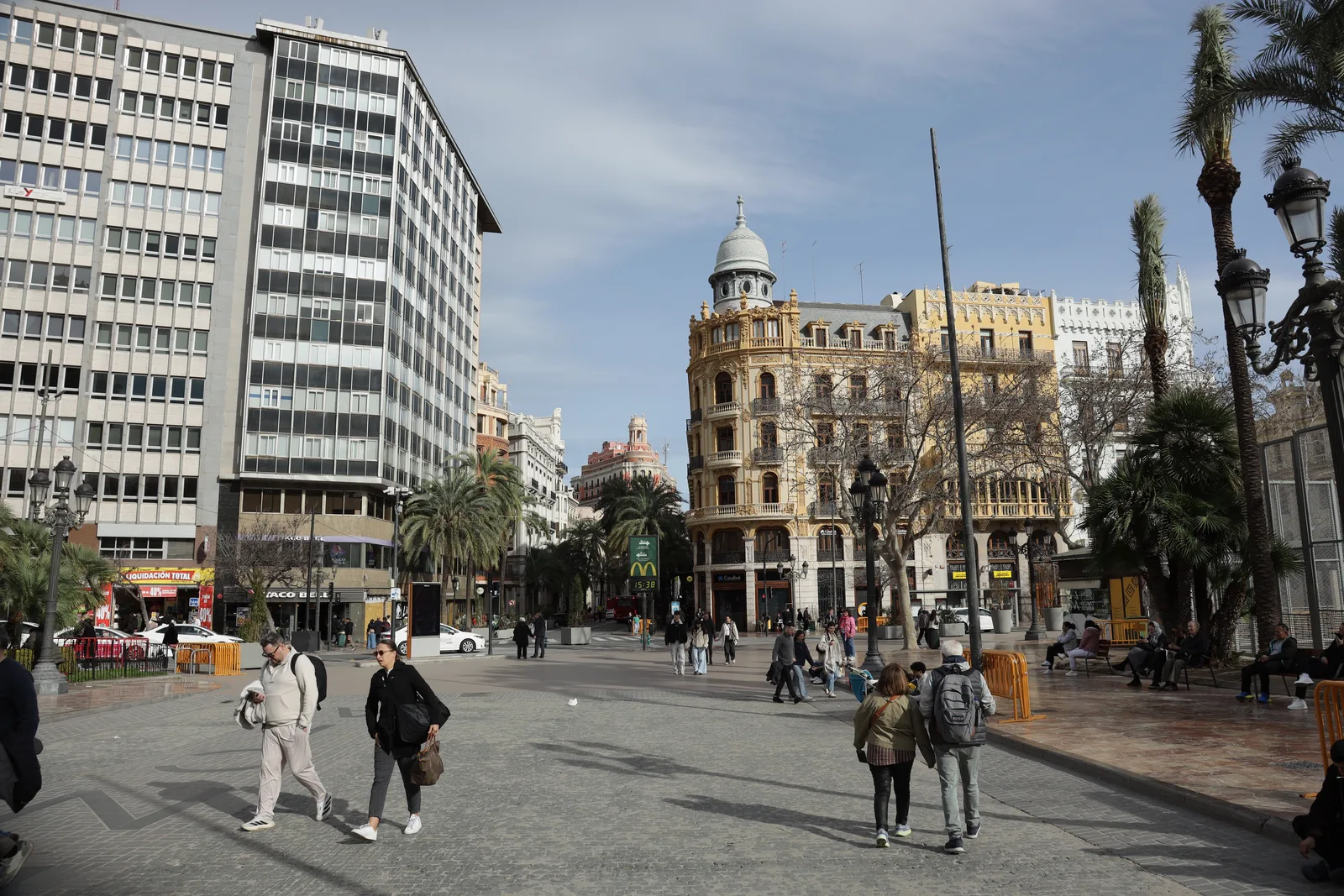
A flag that travels at walking pace
The Real Senyera is not simply displayed indoors and admired from a safe distance on this day. According to local reporting, it is lowered from the city hall and carried through central Valencia, giving the public a moving encounter with an object that otherwise belongs to the Municipal Historical Museum. The procession turns civic heritage into a physical thing: fabric above a crowd, officials adjusting their pace, a route that must be held open.
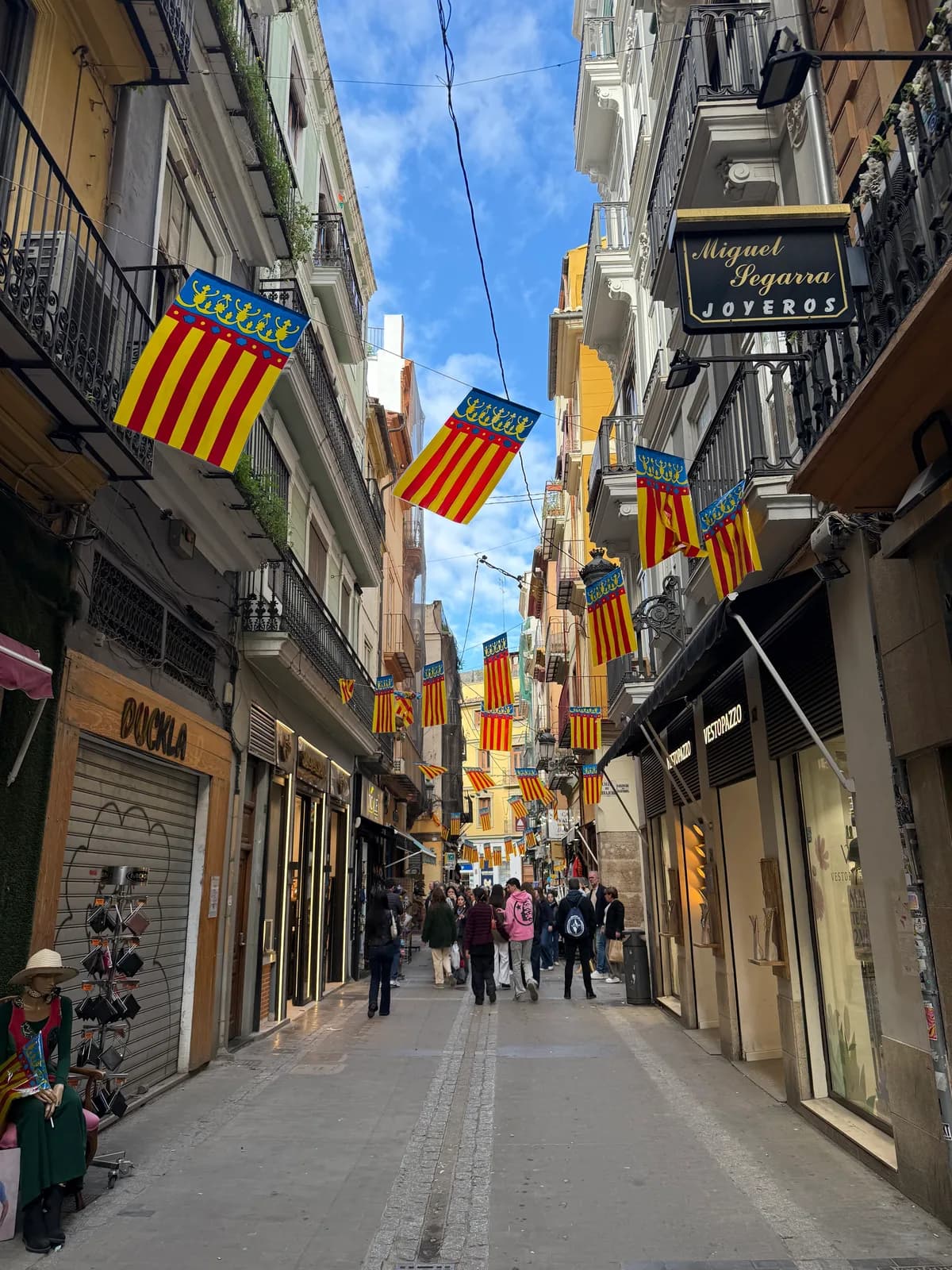
That moving quality is the point. A museum object asks you to enter its room; a procession asks the room to come outside. On streets such as Sant Vicent Màrtir, where local reporting placed some of the strongest applause, the ceremony has to coexist with the ordinary geometry of the centre: narrow sightlines, shopfronts, kerbs, people arriving late and people who have waited for hours.
For visitors, this is a useful correction to the idea that Valencia’s public traditions are spectacles designed for an audience. They are also civic habits. The best way to approach them is less as a consumer of “local colour” and more as a temporary neighbour: choose a sensible place, leave space at crossings, accept that a good view is never guaranteed, and notice the small acts of coordination that make a dense crowd work.
The civic procession’s real achievement is not grandeur but access: a shared symbol only becomes public when people can actually see it pass.
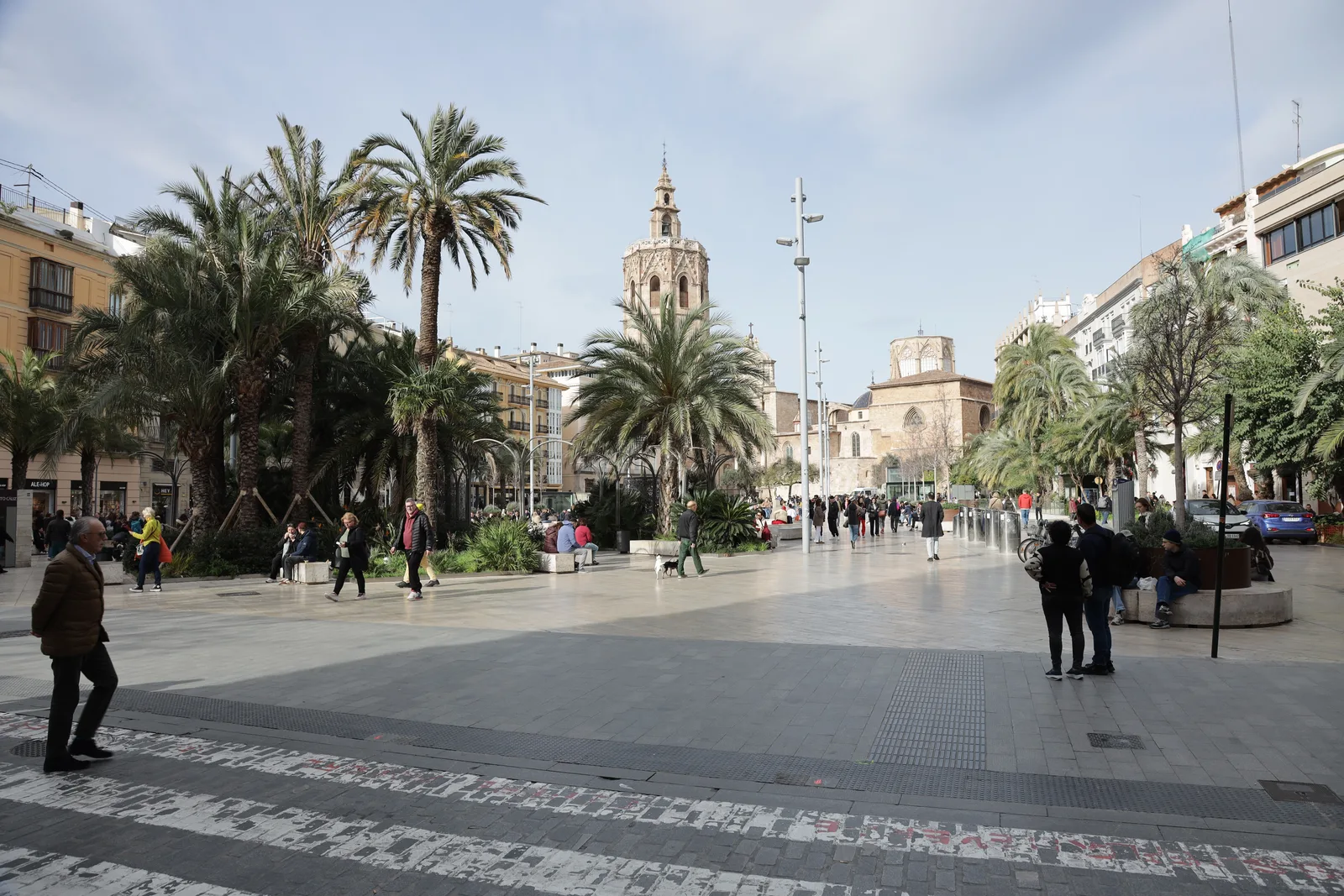
The square is not one thing
Plaça de l’Ajuntament can feel like Valencia’s communal living room on an ordinary afternoon: broad pavement, bus stops, terraces, people cutting across it between Estació del Nord and Ciutat Vella. But it is also a stage that can be fenced, guarded, occupied, celebrated in and argued over. According to local reporting, the arrangement around the housing encampment made much of the square inaccessible for the procession.
That friction is not an interruption to urban life; it is urban life. A central square has competing jobs. It must carry traffic around its edges, hold demonstrations, receive official ceremonies, offer a meeting point to friends and provide a shortcut to someone running for a train. No arrangement can make all of those uses equally easy at once. The consequential question is who loses the view, the route or the right to linger when the space becomes contested.
The mayor was reported to have framed the issue in deliberately broad terms: “La plaza no es del Ayuntamiento, es la plaza de los valencianos y de todos. También la procesión cívica del 9 d’Octubre es la de todos.” The phrase is politically useful because it is also an urban truth. Public places do not become shared by being free of disagreement. They become shared when disagreement does not permanently make them unusable for everyone else.
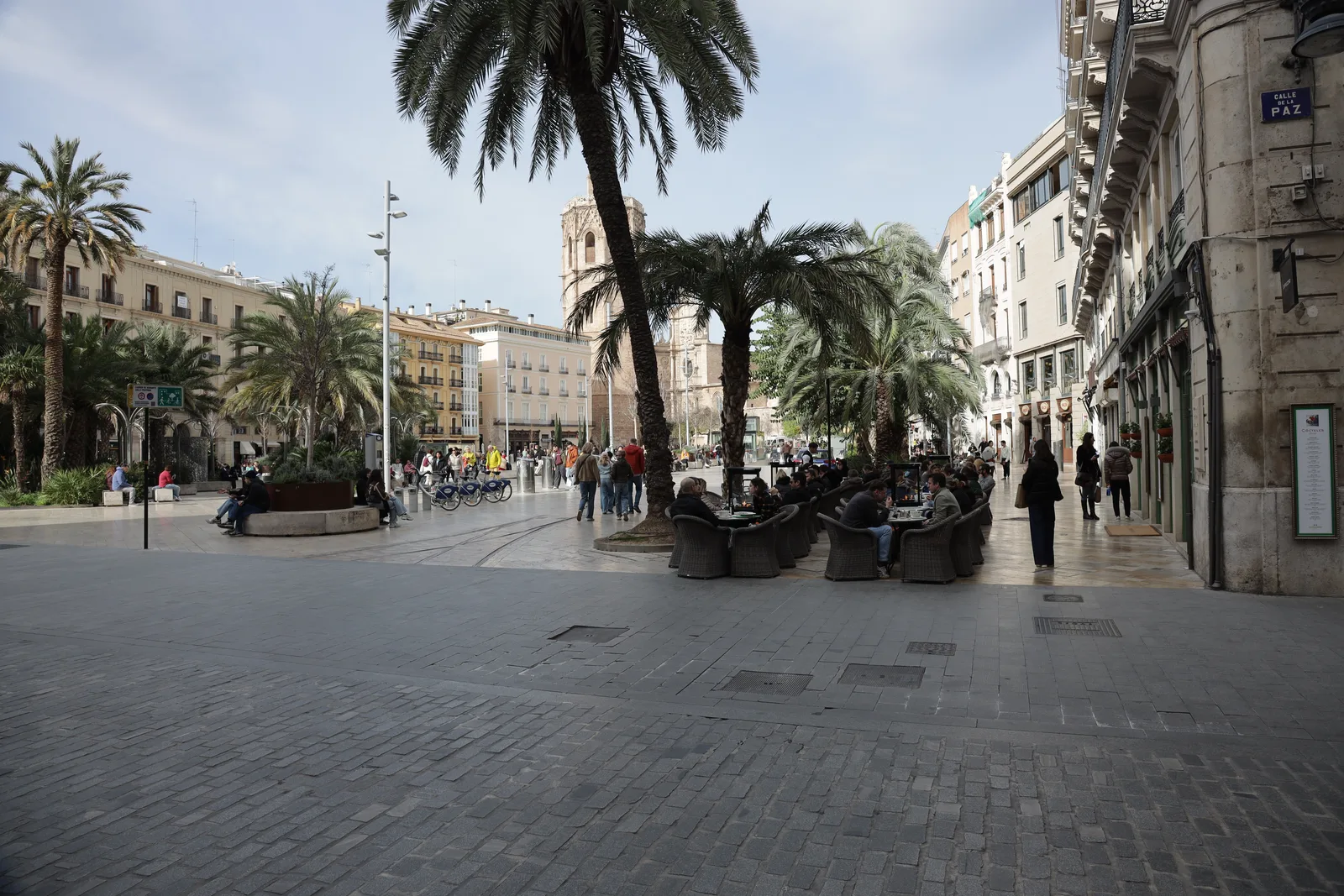
Barriers change the ceremony before it begins
Local reporting said that spectators near Marqués de Sotelo and the Barcas side were unable to get close, while viewing space opened from the Francesc de Vinatea statue onwards. Such details can sound like event logistics, yet they determine the experience more than speeches do. At a procession, the difference between standing behind a barrier and standing at the edge of the route is the difference between hearing that something important is happening and feeling included in it.
Security is often most visible where its purpose is hardest to read. Vans, fencing and controlled entrances can reassure one person and unsettle another. In a ceremonial setting, they also change the choreography: crowds bunch at the permitted gaps, sightlines become prizes and people begin to judge the occasion by what they could not reach. The reported calls to see the Senyera were, in that sense, a request for more than a photograph.
Residents who want to experience major civic occasions comfortably can take a cue from this. Do not assume the grandest square offers the best encounter. A route street may give you a clearer, calmer view and a better sense of the city moving around the ritual. Those learning their way around the centre can find a broader orientation in our guide to Ciutat Vella, where many of Valencia’s public ceremonies eventually spill into everyday streets.
Concord is a street-level skill
According to local reporting, the procession lasted close to two hours and applause outweighed isolated insults. The mayor’s repeated appeal was simple: “Concordia, concordia, concordia, eso es lo que pido.” It is tempting to treat concord as a lofty civic word, but in a crowd it is made of smaller choices—letting a shorter person step forward, lowering a flag or phone for a moment, refusing to turn a tense exchange into an audience event.
The reported appearance of Jaume I’s sword gave this particular procession an extra layer of symbolism, marking the 750th anniversary of his death. Local reporting said the sword had not taken part since 1976. Yet the more durable image is not the rare object itself; it is the route carrying different kinds of Valencians through the same few streets, with no requirement that they agree about everything represented there.
Valencia will keep asking its central spaces to do too many things at once, because that is what living cities do. The useful ambition is not a frictionless square or a silent crowd. It is a city where the next person who comes to watch a flag, make a claim, meet a friend or cross town can still recognise the pavement as partly theirs.
For more ways into the city beyond its headline moments, browse ValenciaLink’s guide to exploring Valencia.