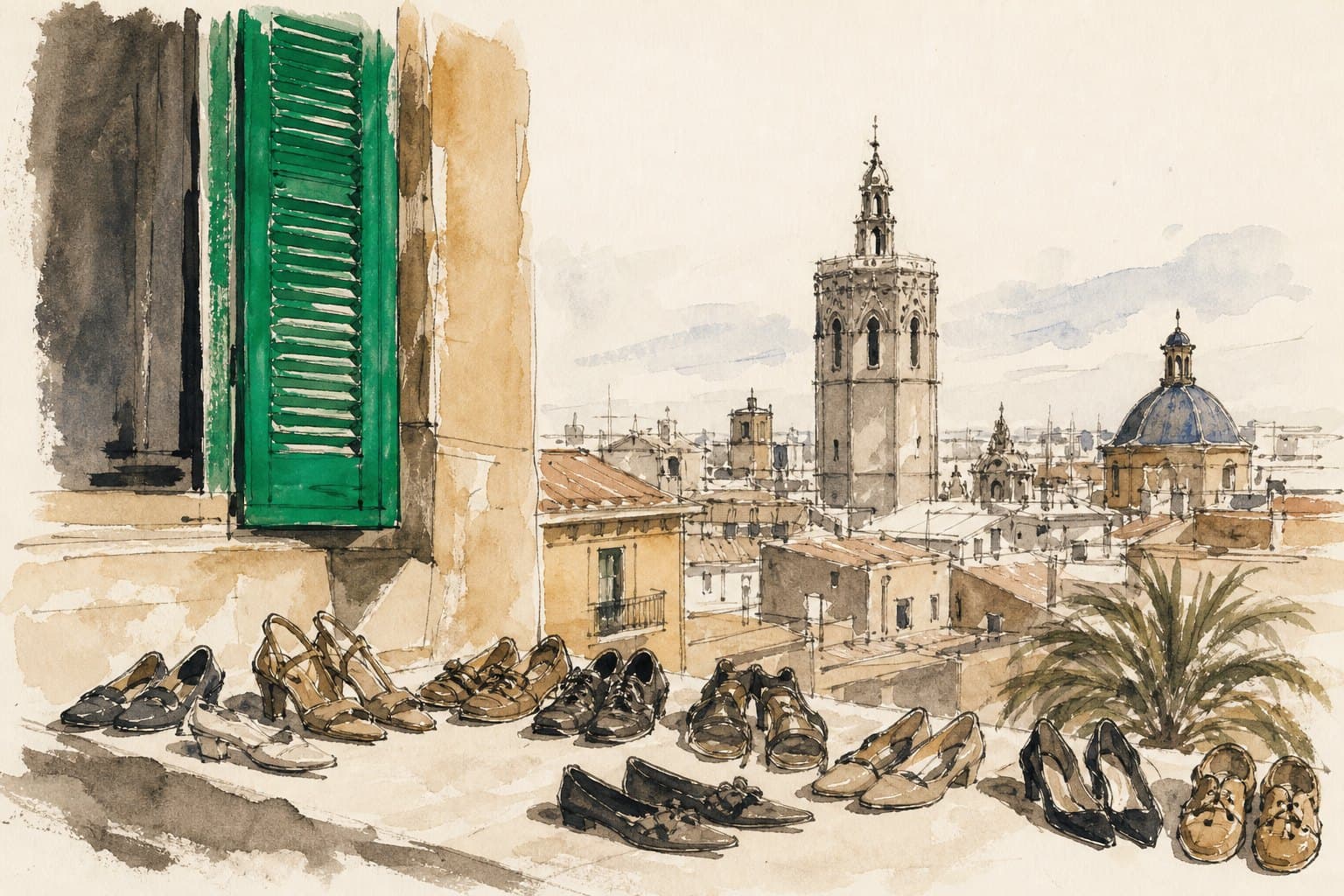
Twelve pairs of trainers leaned against Ofelia’s façade on the seafront at Piles, according to one local account: shoes aired after water had entered the house again. The same report describes sand disappearing from the beach beside it, leaving a domestic scene that is hard to square with the usual postcard idea of the Valencian coast.
That is the useful way to read a story about erosion. It is not only about a line on a map shifting inland, or a dramatic photograph after rough weather. It is about laundry baskets, broken access ramps, empty tables at a beach bar and the uneasy knowledge that the open space between a home and the sea may not stay open.
For people living in Valencia city, the places in that account may feel like a day-trip coastline rather than home territory. Yet they show something that matters all along the shore: a beach is infrastructure as much as scenery. It cushions roads, homes, businesses and ordinary summer routines—until it does not.
A beach is a piece of public space
One local report says that around 100 kilometres of the province’s coastline are affected by erosion, with losses of up to 100 metres at some critical points, including Sagunto. The figures are arresting, but their meaning becomes clearer at ground level. A beach is where children run ahead of their parents, where a bar sets out chairs, where visitors decide whether to stop, and where a promenade has room to breathe.
At Piles, the report describes a shoreline scattered with reeds and wood after flooding, including damage to a wooden bathing walkway. It also records the view from a chiringuito whose owner sees the loss of sand as a recurring problem. Her concern is not framed as an abstract environmental debate: fewer people on the sand can mean fewer people at the tables.
«Al final nos vamos a quedar sin playa».
That sentence, reported from Piles, lands because it contains both fear and economics. A beach does not need to vanish entirely to change a place. It only needs to become less usable, less predictable or less inviting. For a visitor choosing a coast break, and for a resident whose summer income depends on footfall, the width and condition of the sand are part of the experience.
The line between sea and home
The account places Ofelia’s house in a row of seafront properties built in the 1950s and describes their position as legally complicated in relation to Spain’s coastal law. It is a reminder that the coast is never simply natural terrain. It is also a patchwork of old building decisions, permissions, expectations and homes built for a shoreline that may have looked very different decades ago.
According to the report, residents in Piles describe water entering homes at least twice a year. Whether a person is an owner, a tenant or a guest, that detail changes the meaning of “beachfront”. The view that sells a property can also be the route by which salt water, damp and sand arrive.
This is where the language of erosion can become misleadingly calm. “Retreat” sounds gradual, almost orderly. In the scenes reported from the Safor coast south of Gandia, it looks more like furniture outside doors, cars opened up to dry and people waiting beside damaged belongings. A coastline moves by centimetres and metres; households experience it through cleaning, repairs and uncertainty.
For beachgoers, the practical lesson is modest: treat the condition of the shore as part of the plan, not a detail to discover after arriving. A favourite stretch of sand may look very different after severe weather.
Sand does not stay where a postcard puts it
The report records a common local explanation in Piles: residents and business owners point towards the breakwater at Gandia’s port and believe it alters currents, leaving beaches to the south more exposed while sand accumulates elsewhere. It presents this as local opinion, not a settled engineering verdict, but the instinct is revealing. People who live beside the water become close observers of where it carries reeds, timber and sand.
One couple quoted in the account argues for a rock barrier to break the currents; the chiringuito owner makes a similar case. Their proposed solution matters less here than the pattern behind it. When sand seems to leave repeatedly, residents do not speak about one bad day at the beach. They speak about structures, currents and the next season.
The same report notes that money spent on regeneration can be taken away again by the sea, without giving a cost figure. That missing number is almost the point. The value of a beach cannot be reduced to the sand delivered onto it: there are the promenades behind it, the businesses beside it, the homes near it and the expectation that a public coast remains public and usable.
How to look at the coast differently
For international residents, Valencia’s beaches can be easy to file under leisure: a tram ride, a coffee, a swim, a long lunch. That is still a fine way to enjoy them. But the coast also rewards a second look—at the height of a walkway, at where reeds have collected, at the distance from café terrace to water, at the signs of repair along a promenade.
Visitors heading beyond the city can make room for flexibility rather than treating every beach as interchangeable. The local account from Piles, Daimús and Oliva suggests that weather damage and changing sand can shape a destination as much as its online photographs. Ask locally, look down the shore before unpacking, and let the landscape tell you what sort of day it can offer.
Valencia’s relationship with the Mediterranean has always been lived at close range: through fishing ports, apartment blocks, rice fields, promenades and the ritual of going to the beach when the heat rises. If some stretches of sand are becoming more fragile, the response need not be panic. It can begin with attention—the kind that notices twelve pairs of shoes outside a house, and understands that the coast is not a backdrop.
Explore the city’s seaside neighbourhoods and the routes that connect everyday Valencia to the water on our Poblats Marítims guide.