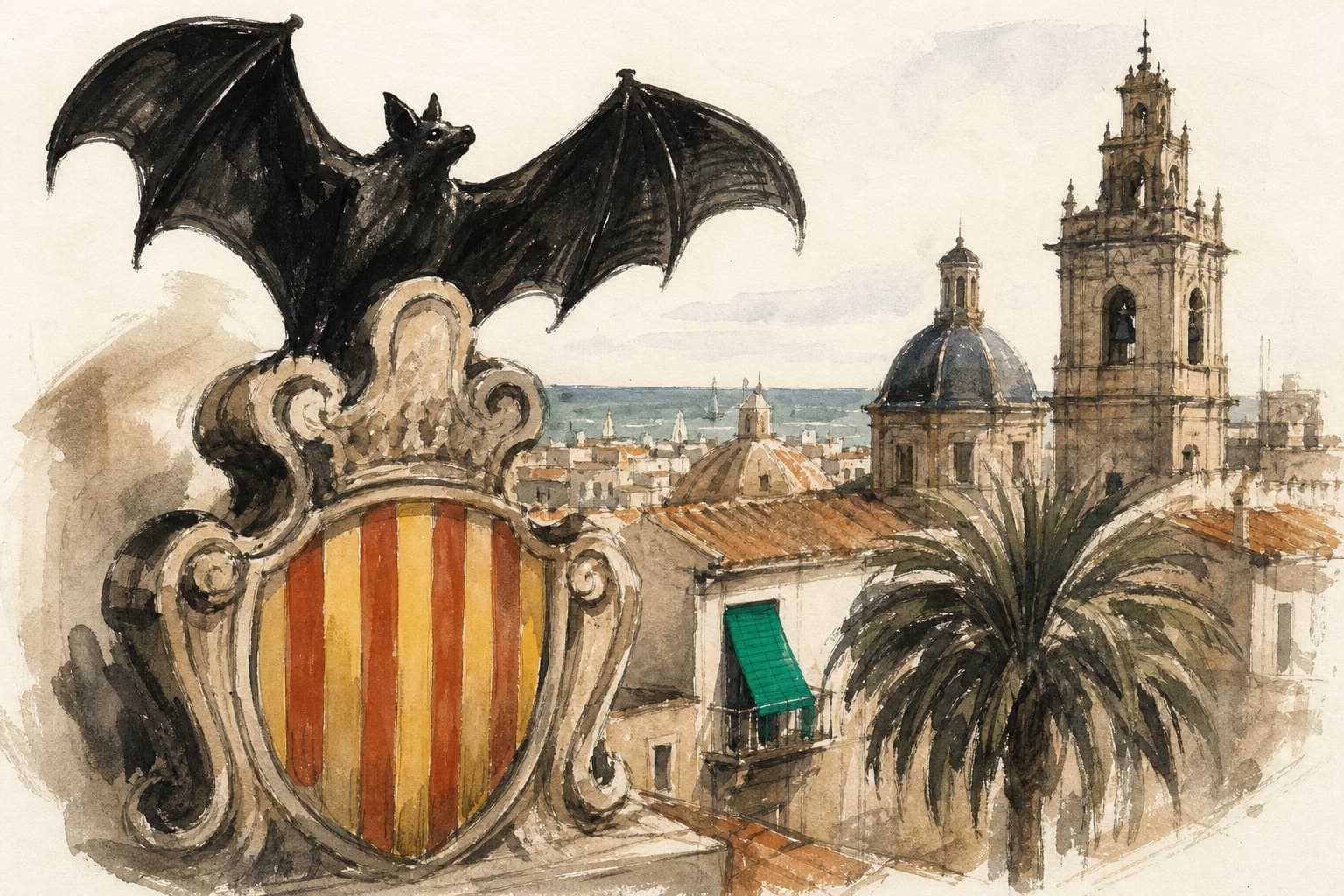
Valencia’s bat, the rat penat, most plausibly developed from a winged dragon on the crest of Peter IV of Aragon. It appeared on some city arms in the early 16th century, and is not recorded above the city’s senyera before 1503.
- Early appearance The bat appeared on some Valencia coats of arms in the early 16th century.
- First recorded crest The bat is not recorded above the city’s senyera before 1503.
- Full arms The earliest cited full arms with stripes, a crown, a front-facing bat and two crowned Ls date to 1633.
- Official emblem The bat became official in the 17th century and appeared on official printed material.
- Likely source The bat follows the vibra, a winged dragon used by Peter IV the Ceremonious.
Why Valencia’s coat of arms has a bat
The strongest explanation is heraldic: Valencia’s bat is traced to the vibra, a winged dragon used as the personal crest of Peter IV the Ceremonious. The source describes this as the more plausible origin of the animal on the city arms.
The winged dragon appeared above the royal helmet during Peter IV’s reign, from 1319 to 1387. It formerly topped the arms of major cities of the Crown of Aragon, including Valencia.
Municipalities later transformed the royal dragon crest into a bat. Over time, the old dragon was identified with a bat and took that form. One proposed explanation is that Valencians mockingly called Peter IV’s winged dragon a ratpenat, which later became the symbol’s name.
The replacement of dragon with bat began around the 17th century and became fully established in the 19th century. Browse Valencia’s districts for more city context.
The James I bat story is a legend
Legend: several stories link the bat to James I the Conqueror and the conquest of Valencia. One says a bat landed on his flag in 1238 before a crucial victory in which he conquered Valencia for his kingdom.
Other versions say the animal landed on the king’s tent and later warned him of a surprise night raid. Another version says it inspired a night attack, or flew before James I when he entered captured Valencia.
A Burriana version says an animal prevented a Crown of Aragon disaster and enabled the conquest of Valencia. In another story, James I protected an animal nesting in his pavilion at Borriana.
These accounts explain why the bat became a good-fortune symbol in the legend. They are not a single historical account of how the crest was formed. For the city’s neighbourhoods and districts, start with Ciutat Vella.
What the documents support
The documented sequence begins later than the conquest stories. The earliest cited full arms combining a striped shield, crown, front-facing bat and two crowned Ls were printed in 1633.
In the 17th century, the bat became official and appeared in official printed material. It has been an official emblem of Valencia since that century and crowns the city’s coat of arms.
The Burriana legend has a further complication: original documents identify the animal as a swallow, not a bat. One version explicitly explains the bat’s origin by confusing it with the swallow James I protected.
That leaves two distinct strands. The heraldic explanation traces the form through Peter IV’s winged dragon, while the conquest stories explain the bat through legend. Use the interactive map of Valencia to explore the city alongside its symbols.
How to read the rat penat today
The rat penat is not presented by these sources as a creature placed on the arms immediately after a battlefield episode. It is a municipal heraldic form that developed from the royal dragon crest, then acquired stories connected with James I.
The bat also belongs to a wider eastern Spanish heraldic pattern. Valencia, Palma, Mallorca and Fraga are among the cities whose coats of arms place a bat above the shield.
If you want the brief version, keep the dragon and the legend separate: Peter IV’s crest is the more plausible source of Valencia’s bat; James I supplies the popular stories.