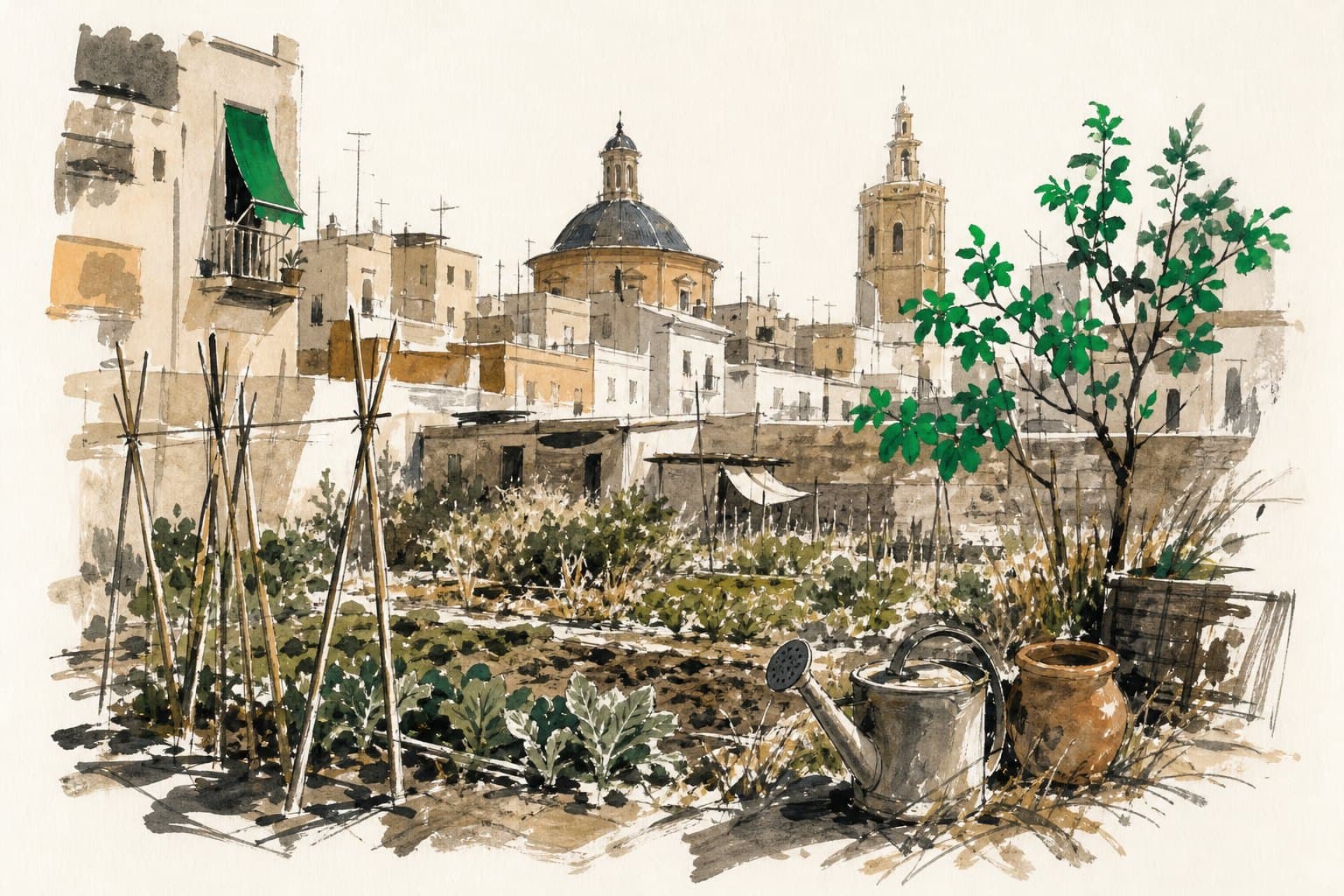
At Sociópolis, the important object is not a ceremonial key but a watering hose that works. Local reporting says 170 residents have signed agreements to cultivate municipal allotments there after the fields and crops were devastated by the 2024 dana, and that they have two months to begin planting before an unused plot can be withdrawn.
That deadline may sound stern beside the usual romance of tomatoes, beans and sunflowers. It is also the detail that explains what an urban allotment is: not a decorative patch of green, but shared land with a waiting list, irrigation, toilets, lockers, soil and neighbours whose growing season depends on one another.
For anyone arriving in Valencia from a city where gardening means a balcony pot or a private terrace, Sociópolis offers a different proposition. The produce matters, of course. So does the chance to learn the slower habits behind it: showing up, noticing whether water is being used sensibly, taking waste away properly and leaving a place workable for the next person.
A plot is a public agreement
Local reporting describes a welcome session at Sociópolis for both incoming and existing users, with guidance on how the gardens operate, how irrigation should be used and how waste should be managed. Those subjects are not glamorous, but they are the machinery that prevents a shared garden becoming a row of abandoned ambitions.
The Consell Agrari de València, according to that report, presented the rules as a matter of caring for plots, respecting facilities and respecting other people’s work. That is a useful way to read the allotments. A plot may be assigned to one grower, but the paths, pipes, bathrooms and basic standard of care belong to everyone using the site.
There is a particular generosity in this kind of rulebook. It makes room for the keen gardener and the novice alike, provided each understands that enthusiasm alone is not enough. A neglected bed affects the person beside it; a misused tap affects a whole network. The garden’s freedom is held up by its ordinary limits.
Before planting comes the unromantic work
The local account says the route back to cultivation included soil recovery, preparation of the plots, checks to internal and external irrigation, and work on shared facilities including lockers and bathrooms. It also says the Consell Agrari commissioned laboratory analysis that found metal levels within normal values and suitable conditions for cultivation, followed by a further technical assessment concerning hydrocarbons.
That sequence is worth lingering over because it corrects an easy image of recovery. After flood damage, reopening a garden is not achieved by putting a rake in the ground and calling it resilience. It depends on testing what is beneath the surface, repairing what carries water and making sure the everyday spaces around cultivation are usable.
Visitors often encounter Valencia through its finished surfaces: the tiled bar, the broad pavement, the market stall piled high with vegetables. A working allotment reveals the backstage version. Food begins with ground that has been checked, water that reaches the bed and a shared place kept clean enough that people will return the following week.
La Torre’s edge of the city
Local reporting places the gathering for users in the pedanía of La Torre, at the Sociópolis facilities. That detail matters because allotments change the meaning of an urban edge. They are neither the quick spectacle of the centre nor the privacy of a country finca; they are a place where city residents can take part in the repetitive, seasonal work normally hidden beyond the ring roads.
Nothing in the reported arrangement suggests that a plot is a shortcut to self-sufficiency, and it would be unfair to pretend otherwise. A small growing space asks for time, attention and patience long before it offers a harvest. Its more immediate reward may be the weekly rhythm: carrying tools, checking leaves, meeting the person who knows what has survived the heat better than expected.
For international residents, this is also a useful distinction to understand. Valencia’s relationship with cultivation is not only something viewed from a restaurant table or during an outing beyond the built-up city. At Sociópolis, according to local reporting, it is organised as a civic use of land: individual labour inside a framework maintained for the wider group.
Gardens need people, not only plans
The report says another plot managed by central technical services still requires preparatory work and that further places are expected to be offered once that is complete. The pending space is a reminder that an allotment garden is never entirely finished. Beds need tending, systems need checking, and access only means something when people actually use it.
The two-month requirement to start sowing carries a simple public logic. Land held aside for cultivation cannot do its job as an empty rectangle of soil. The rule is not about demanding perfect rows or judging anyone’s harvest; it is about making sure a scarce shared resource reaches people ready to put their hands in it.
That is the enduring promise of Sociópolis: a place where recovery is measured not only in repaired infrastructure but in repeated acts of care. As more people look for ways to belong to Valencia beyond consuming it, a tended plot—however modest—shows one route in: learn the rules, bring what you can grow, and leave the ground ready for another season.
For more ways to get to know the city beyond its postcard routes, explore our Valencia guide.