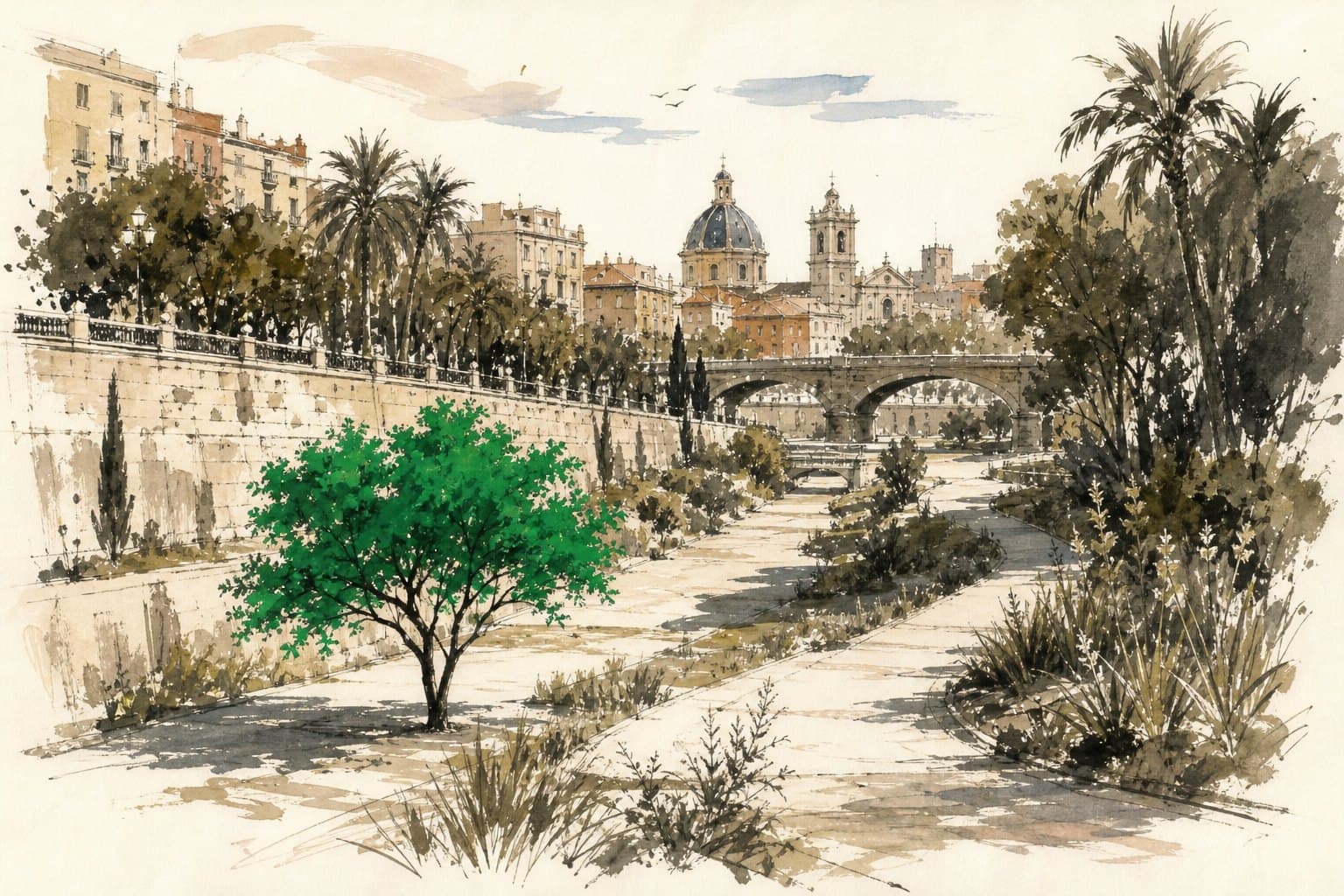
On 14 October 1957, the Turia flooded Valencia, causing major property damage and killing at least 81 people. The river was later diverted south through Plan Sur, and the former channel became the Turia Garden rather than an urban motorway.
- Flood 14 October 1957; at least 81 people died.
- Plan Sur Authorities decided to divert the Turia in 1958.
- New channel Works began in 1964; available accounts give 1972 or 1973 as the completion year.
- Old channel Valencia received ownership in 1976 and the land gained final approval as a public green zone in 1979.
- Park The Turia Garden opened in 1986.
Why is the Turia riverbed a park?
The former riverbed is a park because the 1957 flood led authorities to conclude that the Turia could not safely continue through central Valencia. On that day, the overflowing river released up to 300 million cubic metres of water into the city.
The death toll appears differently in the available accounts. One gives at least 81 deaths; another gives about 100. About 5,800 homes were destroyed, leaving about 3,500 families homeless.
The response was Plan Sur, a flood-protection project intended to move the river south of Valencia. Authorities made the diversion decision in 1958. The Cortes Españolas unanimously approved Plan Sur on 21 December 1961.
The new route ran 3 km south of the original course. One account describes the channel as more than 11 km long, while another gives 12 km in length and 175 m in width. The central channel no longer needed to carry the Turia.
Read our guide to Ciutat Vella.
What did Plan Sur change in Valencia?
Plan Sur moved the Turia south of Valencia and left its former route open for a different use. Construction began in 1964. The available accounts differ slightly on completion, giving 1972 in one and 1973 in another.
The southern diversion created a fast road along its margins, later called the V-30. That road made the original proposal for an urban motorway in the old riverbed unnecessary, because through-traffic and freight traffic could use the new route.
Traffic was directed along the sides of the future garden, with tunnels built in some places to reduce its impact. The sequence matters: first came flood protection and a new river channel; only then did the old bed become available for another purpose.
Who pushed for the Turia Garden?
Valencia residents demanded that the former channel become green space rather than a transport route. A citizens’ movement pushed the site towards recreation and nature.
Its slogan was El llit del Túria és nostre i el volem verd, translated as “The Turia riverbed is ours, and we want it green.” The campaign called for the old channel to remain green.
Valencia received ownership of the old riverbed in 1976 through a decree of Juan Carlos I. In 1979, the land received final approval as a green zone and public park. The Turia Garden opened in 1986.
The result is a public urban park in the Turia’s former riverbed. Its route follows the space left after the river was diverted, rather than a channel built for a new park.
Read our guide to El Pla del Real.
How to understand the Turia Garden today
The Turia Garden is easiest to understand as an old river corridor with two later decisions written into it. The first was to divert the river after the 1957 flood. The second was to keep the abandoned channel as public green space.
The roads at the sides are part of that history. Fast traffic was diverted around the garden, and some tunnels were constructed to limit its impact. The park occupies the former riverbed while the road network runs beside it.
Keep the dates in order when walking through the garden: flood in 1957, diversion decision in 1958, works from 1964, transfer of the old channel in 1976, park approval in 1979, and opening in 1986. That sequence explains why a park now runs where Valencia’s river once flowed.