Valencia burns Fallas monuments around midnight on 19 March because falles are temporary structures made for Saint Joseph’s festival. La Cremà is the festival’s climax, when the monuments become bonfires.
- Festival dates Fallas runs from 1 to 19 March, with its five main days from 15 to 19 March.
- Final night La Cremà takes place around midnight on 19 March.
- Early records Carles Ros described six or seven falles with figures in 1751.
- Organisation The Junta Central Fallera has regulated and coordinated Fallas since 1939.
- Scale La Cremà burns more than 1,000 falles each year.
The short answer: Fallas brings together Saint Joseph’s eve fire customs, neighbourhood organisation and satirical monuments made to burn.
Why does Valencia burn Fallas monuments on 19 March?
Fallas is also called the Saint Joseph’s festival, held in honour of the carpenters’ patron saint. Before the modern monuments, ritual bonfires on Saint Joseph’s eve announced his feast day. That burning practice was called the cremà.
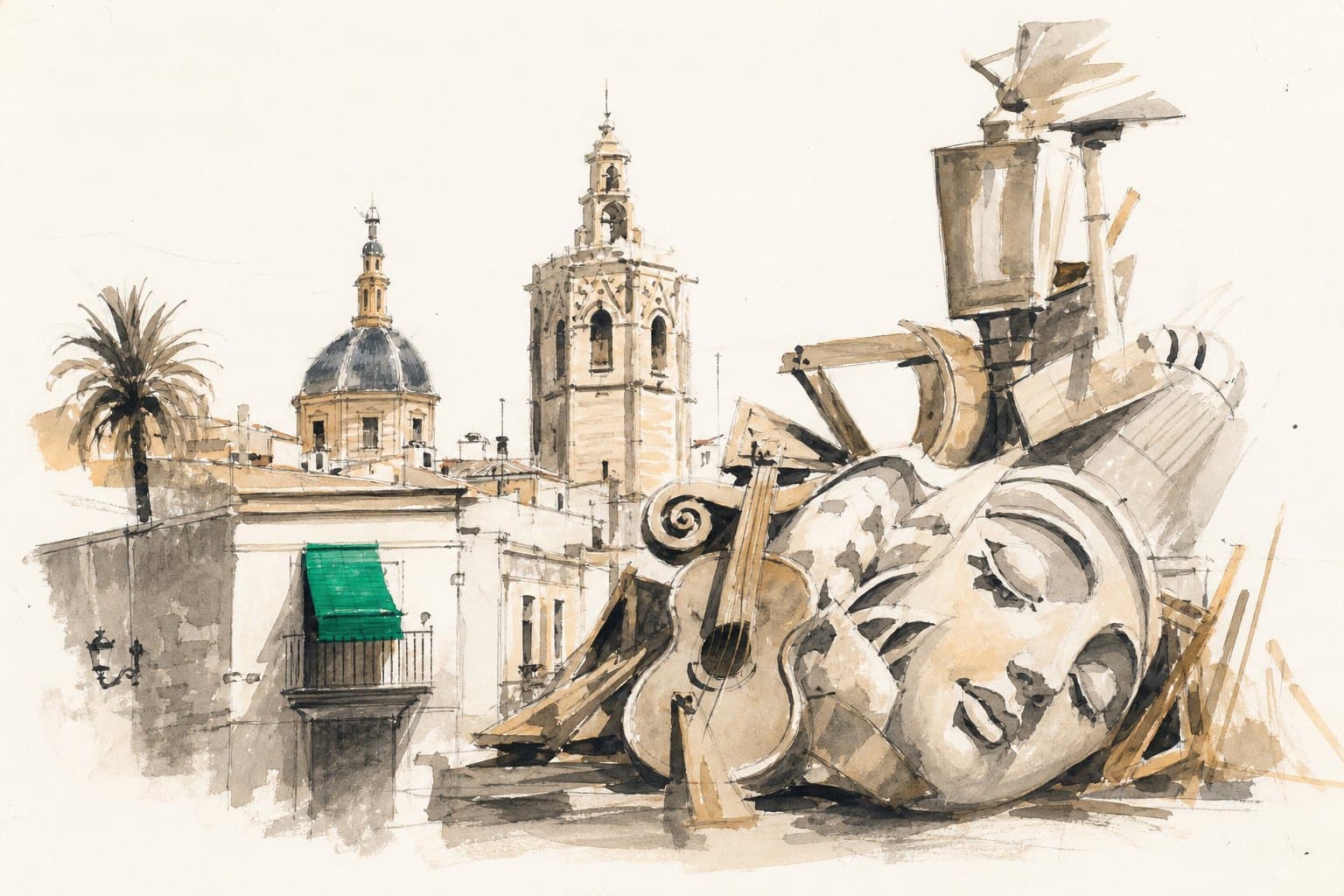
A falla is an ephemeral catafalque with figures, erected in Valencia for Saint Joseph’s festival in order to be burned. Fallas names both the celebration and its monuments. Modern falles are street sculptures: traditionally wood and cardboard, now mostly polystyrene and wood.
The monuments are erected after the Plantà night on 15 March and must stand by the morning of 16 March. They burn four days later, at midnight on Saint Joseph’s night.
Falles and their ninots, or figures, are built around agreed themes. Traditionally, they make satirical jabs at subjects that have caught fallers’ attention. By the late 19th century, wood piles had developed into elaborate platforms with ironic figures depicting people or events from the previous year.
One account says burning the figures offered release from the events they portrayed, or a way to vent against them. That gives the fire a purpose beyond disposing of a temporary sculpture.
Is the carpenters’ origin story true?
The legend: a popular origin story says carpenters burned workshop shavings and old junk before spring in a purifying bonfire. It says they also burned parots, structures used to hold work candles and no longer needed as the days became longer.
In this account, popular invention gave the parots human form. The parot became a clothed figure, often given the features of a person known in the neighbourhood. These parots became the first ninots, while neighbourhood groups later began organising the construction of more elaborate falles.
There is another unproven theory: that Fallas developed from older pagan fire rituals welcoming spring. A related account places medieval artisans at a spring-equinox bonfire, burning broken objects and stored wood. Neither account establishes a single documented origin.
Saint Joseph explains the festival date and the carpenters’ connection. It does not settle the full origin story.
What do the earliest Fallas records show?
The surviving guild records do not confirm the carpenters’ story as a documented beginning. They mention the religious feast on 19 March, but not the construction of fallas on its eve.
Reliable evidence places Fallas in the 18th century. Carles Ros wrote in 1751 of six or seven Valencian falles with figures. The earliest documented reference identified in a notarial protocol is dated 19 March 1777 and concerns a falla on San Narciso street.
A ban on street bonfires in 1784 moved celebrations to squares and street junctions. Monumental falles then proliferated at the expense of simple bonfires.
Fallas is described as having no religious feeling despite its association with Saint Joseph. Religious activities, including the flower offering, were introduced when the Junta Central Fallera was created in October 1939 under Franco.
Who builds and organises Fallas in Valencia?
Fallas is a neighbourhood festival rather than a guild-based one. Each commission meets at a casal faller, its meeting place, and raises money throughout the year for the festival and its monument. Members are called fallers.
Falla artists make the monuments and belong to the Artisan Guild of Falla Artists. Commissions build both large and children’s falles.
Since 1939, the Junta Central Fallera has coordinated Fallas with individual commissions and district boards. It selects the Fallera Mayor, chooses the best fallas across the categories and organises central festival events.
One figure is spared. Since 1934, each falla has submitted a ninot to a popular-vote competition. The winning ninot indultat, or pardoned figure, does not burn in La Cremà.
How does La Cremà work in Valencia?
Each commission produces a falla for burning on the celebration’s final day. On the final night, each falla is loaded with fireworks, which are lit before the construction itself is ignited.
Firefighters use barriers and water to protect people and surrounding buildings from the heat and fire. More than 1,000 falles burn annually during La Cremà, which was declared UNESCO Intangible Cultural Heritage on 30 November 2016.
Browse Valencia’s districts to see the city’s local areas.
For festival listings, see the Valencia agenda.
Use the interactive map of Valencia to move between districts.