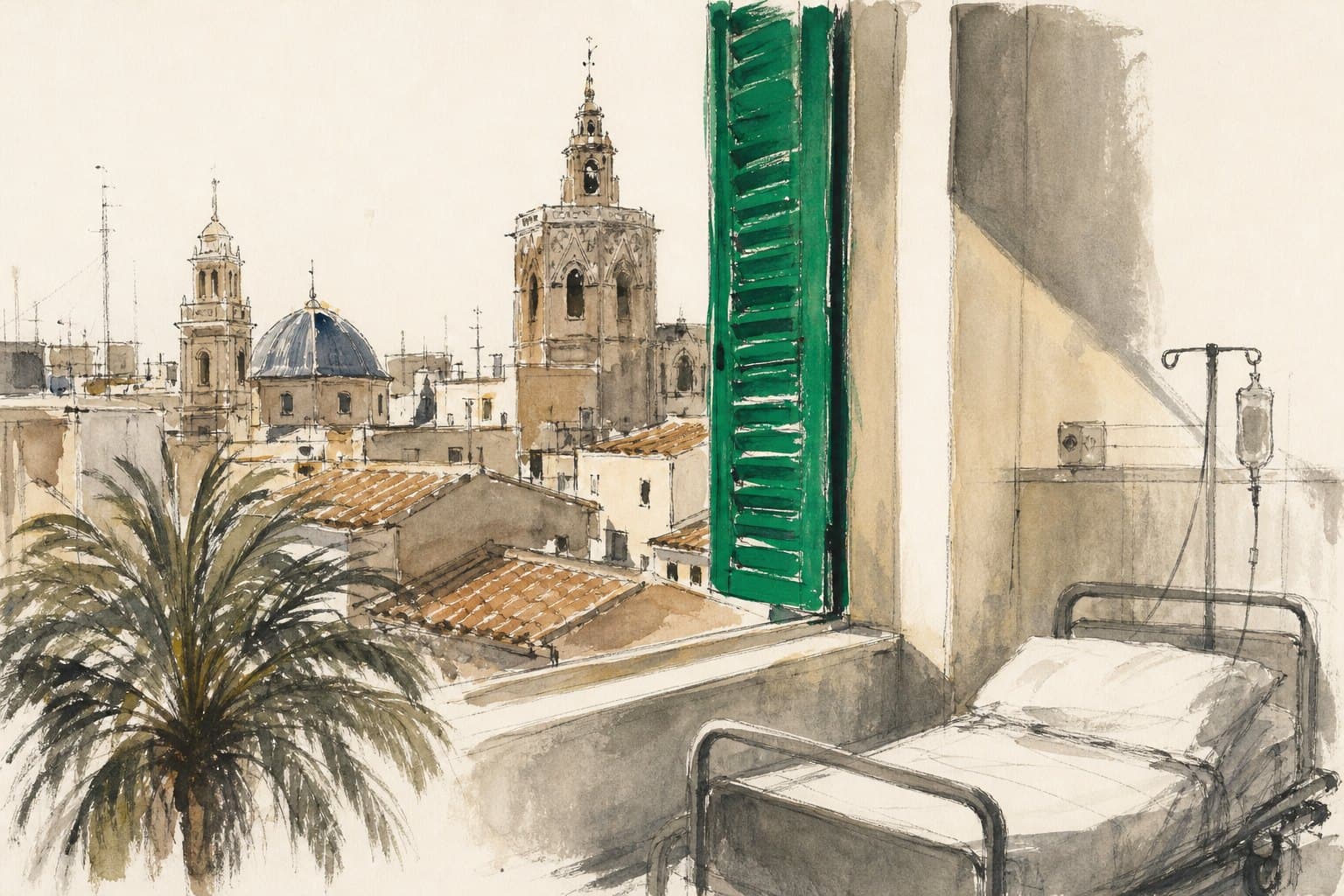
At 15:00, the ordinary working day in Valencia’s public hospitals has traditionally drawn to a close; local reporting says that, outside particular services that organised themselves differently, the later hours resembled a weekend shift, centred on urgent care rather than booked consultations. That boundary is now being tested again. From 1 October, according to the same reporting, ordinary afternoon activity is due to return after its summer pause.
The timetable is a practical answer to a very physical question: what becomes of consulting rooms, diagnostic equipment and operating theatres after the morning staff have finished? Local reporting says the programme was introduced in October 2025, paused at the end of June because holiday staffing made a full day difficult to sustain, and is intended to reopen capacity for specialist appointments, diagnostic tests and operations.
For anyone waiting for a referral to become an appointment, the important change is not that a hospital suddenly becomes a different institution after lunch. It is that the same building may have another usable stretch of scheduled care. That modest shift says a great deal about how a large public service tries to make time, not only space.
The second shift is not an emergency shift
Local reporting distinguishes these ordinary afternoon sessions from the guardias that keep hospitals safe overnight, at weekends and on holidays. The reported plan is for doctors assigned to the afternoon to work then rather than also completing a morning session, with activity generally running until 21:00 or 22:00, depending on how each health department organises itself.
The sessions are reportedly planned for working Mondays to Thursdays, not Fridays or weekends. That makes the timetable feel less like an all-night expansion than a deliberately bounded extension of the weekday: a second window for care, built around staffing limits and the rhythms of a hospital that still needs people ready for emergencies.
Local reporting says afternoon lists tend to concentrate on cases needing fewer staff and less time, while more complex conditions and interventions remain largely a morning responsibility. Patients should not read an afternoon slot as a lesser appointment. It is better understood as a sign that the case fits a particular team, room and level of support at that hour.
Waiting lists are made of several different waits
“The waiting list” sounds singular, but local reporting says the returned sessions are aimed at three separate bottlenecks: specialist outpatient consultations, diagnostic testing and operating theatres. Those are connected waits, yet they are not interchangeable. A person may be waiting to see a specialist, then for a scan, then for a procedure; opening more time at one stage does not automatically clear the next.
That is why the afternoon programme is most easily understood as a way of adding scheduled slots where a department can safely provide them. Local reporting says its biggest expected effect is on specialist outpatient appointments and diagnostic tests. The hoped-for result is a shorter delay, but the reporting also says health authorities have not published concrete figures showing the programme’s impact on waiting times or patient attendance over the preceding year.
There is an honesty in that missing number. A later appointment can be valuable even before anyone can calculate its system-wide effect: it may save a patient from taking an entire morning away from work, childcare or study. But it also makes sense to separate convenience from proof. A timetable is an offer of capacity; whether it reduces a particular person’s wait depends on the specialty, the test, the hospital and the queue already in front of them.
One city, several hospital timetables
Valencia’s public hospitals do not operate as one giant reception desk. Local reporting says each centre will decide how much of its staff to dedicate to afternoons according to personnel availability, internal organisation and the volume of its waiting list. The 1 October return is therefore a common direction, not necessarily an identical experience at every hospital.
The same reporting says doctors may be scheduled for no more than six afternoons a month. It also reports that no additional staffing was announced for the programme, meaning that in practice clinicians may be moved from morning work into the later shift. That detail matters because a service can appear to gain hours while still having to redistribute the same finite number of professionals.
For residents, this is a useful reminder to treat appointment letters and hospital messages as the real timetable. A neighbour’s experience at another centre, or even in another specialty, may not predict yours. If a later slot is offered, the sensible questions are simple: which building, which department, what preparation is required and whether the time changes any transport or companion arrangements.
What a later slot changes outside the hospital
An appointment ending near 21:00 or 22:00, as local reporting says some departments may schedule, reaches beyond the consultation room. It reshapes the small logistics around care: collecting a child, arranging someone to accompany an older relative, getting home after a test, or fitting a specialist visit around a job whose hours cannot easily move. The value of an afternoon service is often measured in those ordinary negotiations.
It also asks patients to be alert to the difference between a planned-care extension and an urgent-care route. Local reporting is clear that the afternoon programme concerns booked consultations, tests and selected procedures; emergency needs remain the work of emergency services and hospital guardias. A later clinic can widen access, but it does not turn every hospital desk into an after-hours walk-in service.
As Valencia’s hospitals make more use of the day after lunch, the city’s healthcare map becomes a little less tied to the morning. That will matter most when the arrangement is legible: when patients know what sort of appointment they have, what the later hour is designed for, and how to plan the journey around it. For practical local resources, see our health guide.